Join the Crew
Get the best resources for producers delivered to your mailbox

Get the best resources for producers delivered to your mailbox


The Wrapbook Team consists of individuals who are thrilled about building modern software tools for creators. We’re a team of compassionate and curious people dedicated to solving complex problems with sophisticated solutions. You can find us across the U.S. and Canada.
At Wrapbook, we pride ourselves on providing outstanding free resources to producers and their crews, but this post is for informational purposes only as of the date above. The content on our website is not intended to provide and should not be relied on for legal, accounting, or tax advice. You should consult with your own legal, accounting, or tax advisors to determine how this general information may apply to your specific circumstances.
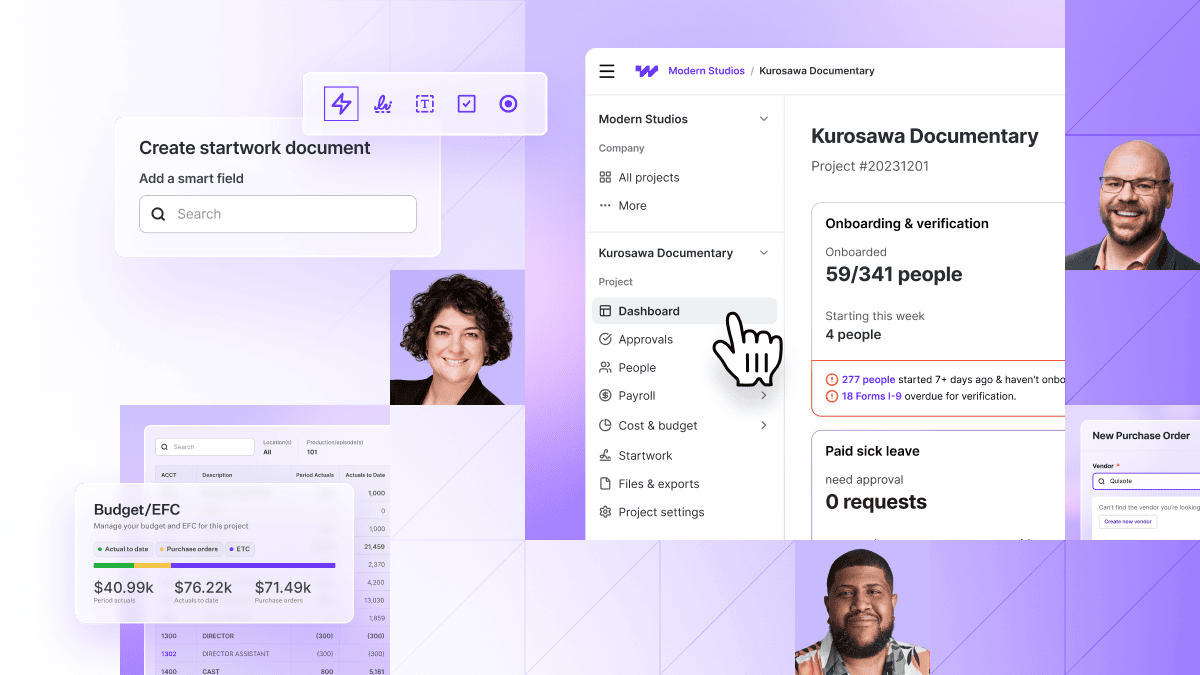
For Mike Fiore, CFO of RadicalMedia, the key to staying ahead in today’s production industry is information. And with the right system, he says, “You have real-time information at the touch of a fingertip.”
Not after someone pulls together three spreadsheets. Not after a status meeting. Right when the decision needs to be made.
For many accounting and production finance teams, the challenge is not a lack of information. It’s how many systems, people, and steps sit between the question and the answer. Payroll lives in one system. Approvals sit in someone’s inbox. Cost data may be current, or it may be lagging behind a few days of manual work. Arriving at an answer often means assembling it first.
And that takes time—time that nobody has.
While finance leaders wait for answers, budgets drift, approvals stall, and the window to address problems narrows or even closes entirely. For years, leaders have tried to close this gap with more process—more check-ins, more reporting, more oversight. But you cannot process your way out of a structural problem.
The finance leaders pulling ahead in today’s industry are the ones who recognize that addressing the information gap is now a key dimension of their leadership. And the best leaders are the ones who are choosing to build environments where the answer is not something they have to wait for. It’s already there.
Most productions are not short on capable people. The issue is not whether your accountants and finance team can get the answer; it’s how long it takes to get there.
In Wrapbook’s 2026 State of Production Finance & Accounting Report, more than 80% of accounting teams said they still rely on manual processes for core AP tasks. That matters because when critical information depends on manual work across systems, lag becomes part of the operating model.
And that lag carries real risk. Imagine a department is waiting on approvals tied to spend that affects the schedule. Finance might not see the bottleneck clearly until production has already slowed, and at that point, the issue is no longer prevention; it’s damage control.
When access to information is continuous, finance can work differently. Leaders can spot movement earlier, intervene sooner, and address issues before they start affecting budget and schedule. That’s the difference between having data in a haystack and being able to find the needle on demand.
For years, skilled accounting teams have spent too much time assembling information that already exists: tracking down approvals, matching invoices to POs, rebuilding context across systems. Instead of their software being the source of truth for financial data, production accountants are left to fill that role themselves. No matter how excellent a production accountant might be, this siloing of information creates a significant bottleneck.
Finance is most effective when it can see where production is heading, identify where intervention is needed, and act before problems get expensive. When payroll, accounting, spend, approvals, and documentation live in one environment, the question shifts from “Can someone pull this together?” to “What does this tell us?”
That’s a different operating model.
The strongest organizations are not just asking for faster reports. They are rethinking how finance operates.
The best production accountants have long operated like air traffic controllers, expected to hold everything in view and answer quickly from every direction. What they have often lacked is the equivalent of radar: a system that shows the full picture live, in one place.
That matters more now. Productions are more complex. Reporting expectations are tighter. Stakeholders want answers faster.
The organizations pulling ahead are not just improving reporting. They are changing the model—giving finance infrastructure that makes sure information is current, connected, and usable when decisions need to be made.
If your team can get the answer, but only after pulling it together across systems, how much room to act is being lost in the process?
Production finance has always depended on people who know how to find the answer. What is changing is how much work it should take to get there. When finance no longer has to assemble the full picture first, it can spend less time reconstructing the past and more time shaping what happens next.
Explore how finance leaders are operating with answers on demand.