
Join the Crew
Get the best resources for producers delivered to your mailbox

Get the best resources for producers delivered to your mailbox


The Wrapbook Team consists of individuals who are thrilled about building modern software tools for creators. We’re a team of compassionate and curious people dedicated to solving complex problems with sophisticated solutions. You can find us across the U.S. and Canada.
At Wrapbook, we pride ourselves on providing outstanding free resources to producers and their crews, but this post is for informational purposes only as of the date above. The content on our website is not intended to provide and should not be relied on for legal, accounting, or tax advice. You should consult with your own legal, accounting, or tax advisors to determine how this general information may apply to your specific circumstances.
Next-gen tech. Concierge service. Innovation that keeps you a step ahead.
94%. In a recent survey, that's the percentage of our commercial clients that say they feel more in control of their finances after switching to Wrapbook. And while we'd love to just sit around and pat ourselves on the back about that number, it also reveals something important: namely, that a great many commercial teams have been feeling a lack of control over their finances.
What does that lack of control mean for a Head of Production? For a CFO? Matt Sanders, HOP at Superprime, puts it plainly:
"I've always kind of felt like I've been in a dark hole with payroll—not being able to get the information that I need or generate the reports I want."
But while visibility is certainly part of it, control isn't any single thing. It's having the information you need when you need it—not pieced together after the fact. It's having enough runway ahead of problems to actually solve them, rather than spending the whole production in catch-up mode. And it's knowing that if anything ever comes up after wrap, your financial record is already there—built into the process from day one, not assembled after the fact.
The answer, in other words, runs the full length of a production—and it looks different at every stage.
Project setup is the moment that determines everything downstream—crew structure, compliance requirements, financial architecture. When setup takes a week instead of an hour, you're not just losing setup time. You're compressing every subsequent deadline and starting behind before production has even begun.
In a recent survey of commercial Wrapbook users, 75% can now set up a project in under an hour. Before, only 33% could say the same. For a production running on a compressed timeline, that gap isn't a minor operational improvement—it's the difference between getting ahead of problems and spending the whole production catching up to them.
But speed isn't the only thing at stake. The errors that enter at setup don't stay in setup.
An incorrect rate—entered manually, without software that flags the discrepancy—becomes a payroll problem the moment the first timecard is processed. A payroll problem that isn't caught quickly enough becomes a compliance exposure. And incomplete startwork means your team is already chasing paperwork on day one, before production has found its footing. Problems seeded at the beginning have a way of compounding forward. By the time they surface, they're no longer setup problems—they're payroll problems, compliance problems, or both.
As anyone who works in commercial production will tell you, it moves fast. Even teams with a clean setup will face the occasional hiccup—a missing timecard, a late-breaking vendor invoice, a crew member who didn't complete startwork before the payroll window closed. Being in control isn't about avoiding every problem. It's about having the information to respond quickly and correctly.
For most commercial teams, that information exists, but it's scattered in too many places to be useful. It lives in email threads, in spreadsheets that someone built and only they fully understand, in payroll systems that don't talk to the spend management platform, in vendor portals that require a separate login. By the time you've pulled it all together, it's already behind. And the act of pulling it together is itself a kind of work that shouldn't have to exist.
RadicalMedia COO/CFO Mike Fiore describes what the alternative looks like:
"With Wrapbook's portal and platform, the ability to pull just-in-time reports—you have real-time information at the touch of a fingertip."
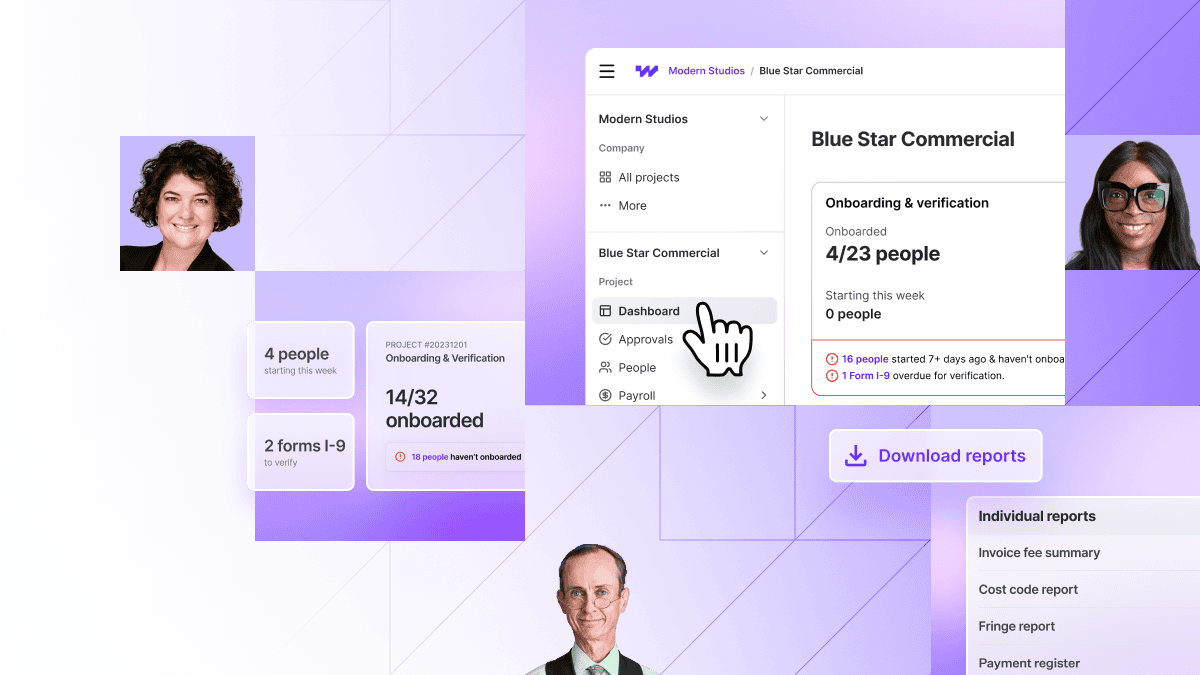
When all of that information lives in one place and updates in real time, the aggregation work disappears. You're not building a picture of your financials—it's already there. The decisions that used to wait for the numbers to catch up can be made with confidence, at the moment they actually matter.
It’s not that the teams that felt out of control were understaffed or under-resourced. It’s that they were working with tools that required them to hold the financial picture together manually—re-keying payroll data, chasing missing startwork, reconciling timecards across systems that weren't talking to each other. As Assistant Controller Courtney O'Brien described it, her old payroll process was "very manual and very error-prone."
Managing payroll meant navigating a minefield of paper timecards, spreadsheet calculations, missing paperwork, and never-ending email chains. Every pay cycle introduced opportunities for error and required enormous time investment just to get the basics done. These weren't extraordinary circumstances; that was a normal week. And on a production already running at full speed, a normal week that requires that kind of overhead leaves less room for everything else.
Wrap is where everything that wasn't handled earlier comes due.
The rate that was entered incorrectly at setup. The timecard that got re-keyed with a mistake halfway through production. The startwork that was never quite complete. By the time the production closes out, these aren't small loose ends—they're the financial record. And if that record was built by hand, across systems that weren't talking to each other, reconciling it at wrap is a project in itself.
94% of commercial Wrapbook users said compliance got easier after switching. For a CFO, that number means something specific: fewer exceptions to chase down, fewer questions about whether a payroll run was correct, less time spent proving after the fact that everything was done right.
Because the compliance risk in commercial production doesn't end at wrap—it lingers. Wage and hour claims, misclassification questions, benefit eligibility disputes: these can surface months or even years later. When that happens, the question isn't whether you were compliant. It's whether you can prove it. A financial record assembled at the end, from memory and spreadsheets and email chains, is a much harder thing to defend than one that was built into the process from day one.
Built-in compliance means wrap is a confirmation, not a reconstruction. The record is already there—accurate, complete, and ready if it's ever needed.
The financial pressure on commercial production isn't easing. But the tools have finally caught up to what the work actually demands. Real-time financial clarity. Project setup that doesn't burn a week. Compliance that's structural, not an afterthought. These aren't competitive advantages anymore—they're the baseline for how the best teams operate.
The teams that reach it aren't just more efficient. They're making better decisions, because they're making them with the full picture in front of them, at the moment those decisions actually matter.
In an environment where so much is unpredictable, that's the advantage that compounds.
Want to see what commercial clients are saying about how Wrapbook gives them control? Check it out here.

