Join the Crew
Get the best resources for producers delivered to your mailbox

Get the best resources for producers delivered to your mailbox


The Wrapbook Team consists of individuals who are thrilled about building modern software tools for creators. We’re a team of compassionate and curious people dedicated to solving complex problems with sophisticated solutions. You can find us across the U.S. and Canada.
At Wrapbook, we pride ourselves on providing outstanding free resources to producers and their crews, but this post is for informational purposes only as of the date above. The content on our website is not intended to provide and should not be relied on for legal, accounting, or tax advice. You should consult with your own legal, accounting, or tax advisors to determine how this general information may apply to your specific circumstances.
Production finance leaders operate in one of the more demanding corners of the entertainment business. Tight payroll deadlines, multi-show oversight, incentive reporting requirements, and relentless cost pressure are the baseline. In that environment, every unnecessary dependency on a payroll provider isn't just an inconvenience. It's a structural liability.
The question isn't whether payroll providers matter. They do. The question is more specific: what should your team be able to do on their own, without submitting a ticket, waiting on a callback, or routing a routine task through an external system?
The friction rarely announces itself. It accumulates in small moments: a worker detail that can't be adjusted without approval, a report that requires a provider to rerun, a coding correction that has to wait until someone on the other end is available. Individually, none of these feel catastrophic. In aggregate, they extend close cycles, slow cost reporting, inflate reconciliation time, and reduce your team's ability to respond when it actually matters.
Common friction points include:
Each of these represents a moment where your team's expertise and judgment are ready, but the system isn't built to let them act on it.
Modern production finance platforms should be designed around a clear principle: routine workflows belong to your team. Provider involvement should be reserved for complexity, escalation, and edge cases, not the everyday execution of tasks that a capable team is fully equipped to handle independently.
That autonomy generally falls into three categories.
Finance executives should ensure their team has the access they need to move without friction. When a team member is designated as a company admin, they should have access to everything: real-time payroll status, the ability to make approved adjustments within guardrails, prior payroll history, and standard reporting, all without submitting a request to their payroll provider.
Payroll is time-sensitive by nature, and unnecessary dependencies create downstream risk across the entire production. Company admins in particular shouldn't be hitting those kinds of roadblocks, and if they are, that's a platform problem worth addressing before it becomes a payroll problem.
For production finance leaders, the ability to pull data on demand, without routing a request through a payroll provider, is a baseline expectation that not every platform meets. Your team should be able to access cost reports, GL exports, and historical transaction logs independently, and generate audit-ready documentation without waiting on external support. That need for on-demand access doesn't disappear at year-end; if anything, it intensifies.
Year-end 1099 compliance is where provider dependency tends to surface most visibly. It's one of the most time-consuming processes your team faces annually, and a platform that makes it harder, through clunky workflows, manual exports, or error-prone filing, compounds an already demanding period. Your team should be able to manage vendor tax reporting, track 1099s, and file directly within the system, without touching external spreadsheets or routing data through third-party processors.
If your current platform requires your team to submit requests for standard reporting or creates friction around year-end filing, that's a structural problem, not a workflow one.
Beyond day-to-day operations, mature systems should give your team the ability to manage permission controls, update department coding, handle batch management, and adjust internal approval routing, all within defined guardrails. The goal is not to create an open system without controls. It's to ensure that the people who understand the production best aren't blocked from making the adjustments they're authorized to make.
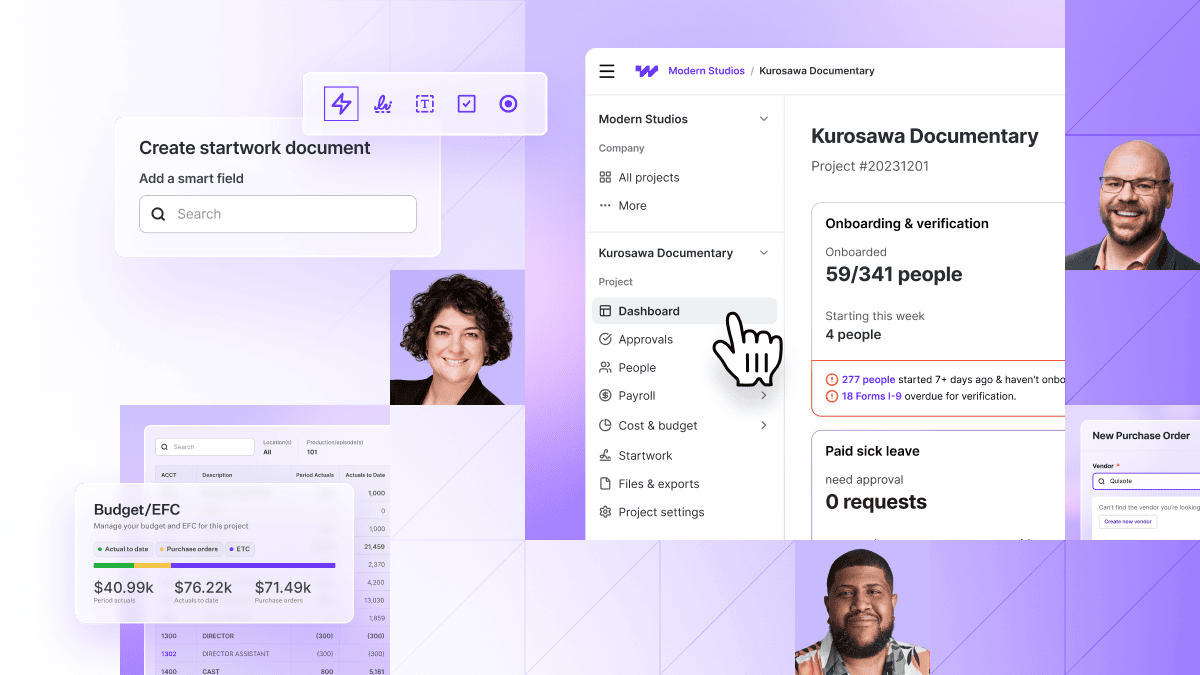
Within Wrapbook, clients can edit transaction details directly in the production accounting system, with guardrails built into the platform through approval flows, permission roles, and period controls. One intentional limitation: transaction descriptions cannot be edited after the fact, a design choice that protects against fraud. On the payroll side, once a payroll is fully processed and funded it is final. Any necessary corrections are handled through subsequent payroll adjustments rather than edits to the original record.
Any honest conversation about self-service has to acknowledge its limits and doing so actually strengthens the case for autonomy elsewhere.
Certain areas genuinely require external expertise: compliance verification, regulatory interpretation, union rule clarification, and escalation for edge cases that fall outside established workflows. These aren't areas where your team should be operating unilaterally, and a well-designed platform won't ask them to.
The distinction matters. Autonomy should enhance discipline, not bypass controls. When the boundaries are clearly defined, your team knows exactly where they can move quickly and where they should pause.
It's worth being explicit about what operational autonomy actually means, because the concern is sometimes that reducing provider dependency means reducing support altogether. That's not the trade-off.
Autonomy means routine workflows are self-service. It means escalations are strategic rather than operational, reserved for genuinely complex situations rather than tasks your team could handle themselves with the right access. And it means provider involvement becomes more valuable, not less, because it's concentrated where it actually adds something.
In practice, the degree of autonomy a platform offers varies significantly across the industry. A team that has real self-service access to payroll status, reporting, and configuration settings operates very differently from one that has to route routine requests through a support queue. The former can focus on the production. The latter is managing the platform.
A team that can execute independently on the day-to-day isn't a team that no longer needs partners. It's a team that can have better conversations with those partners about the things that matter most.
The operational case for self-service is straightforward. The organizational cost of the status quo is underappreciated.
When workflows are constantly interrupted by dependencies outside of your team’s control, such as repetitive ticketing, report delays, and configuration changes that require external sign-off, the frustration compounds over time. Talented people leave. Institutional knowledge walks out with them. Recruiting and onboarding replacements in a specialized field is expensive and slow.
When your team can execute without constant dependency, close cycles accelerate, output improves, and your organization retains the people who make that performance possible. A platform that gives your team the autonomy to do their jobs without unnecessary friction isn't just a workflow improvement; it's a retention strategy.
When assessing a platform's approach to self-service, the most useful questions shift from "what features do you offer?" to something more specific:
Autonomy is measurable. The answers to these questions reveal whether a platform is designed around your team's ability to operate or around its own support model.
As production budgets tighten and reporting requirements grow more complex, accuracy alone is no longer enough. Production finance leaders need control over their team's workflows, their data, and their organization's ability to act when the production demands it.
The strongest production finance environments balance structured governance, defined guardrails, and genuine operational autonomy. Bottlenecks reduce margin. Autonomy reduces bottlenecks. And giving your team the tools to operate independently, within the right controls, protects both the people doing the work and the profitability of the productions they support.
Ready to see what operational autonomy looks like in practice? Book a demo to explore how Wrapbook supports production finance teams.