Join the Crew
Get the best resources for producers delivered to your mailbox

Get the best resources for producers delivered to your mailbox


Allison Takeuchi is Wrapbook's Chief Product Officer. She has over twelve years of experience leading Product, Engineering, & Design teams and remains passionate about solving core problems that impact the day-to-day lives of Wrapbook customers.
At Wrapbook, we pride ourselves on providing outstanding free resources to producers and their crews, but this post is for informational purposes only as of the date above. The content on our website is not intended to provide and should not be relied on for legal, accounting, or tax advice. You should consult with your own legal, accounting, or tax advisors to determine how this general information may apply to your specific circumstances.
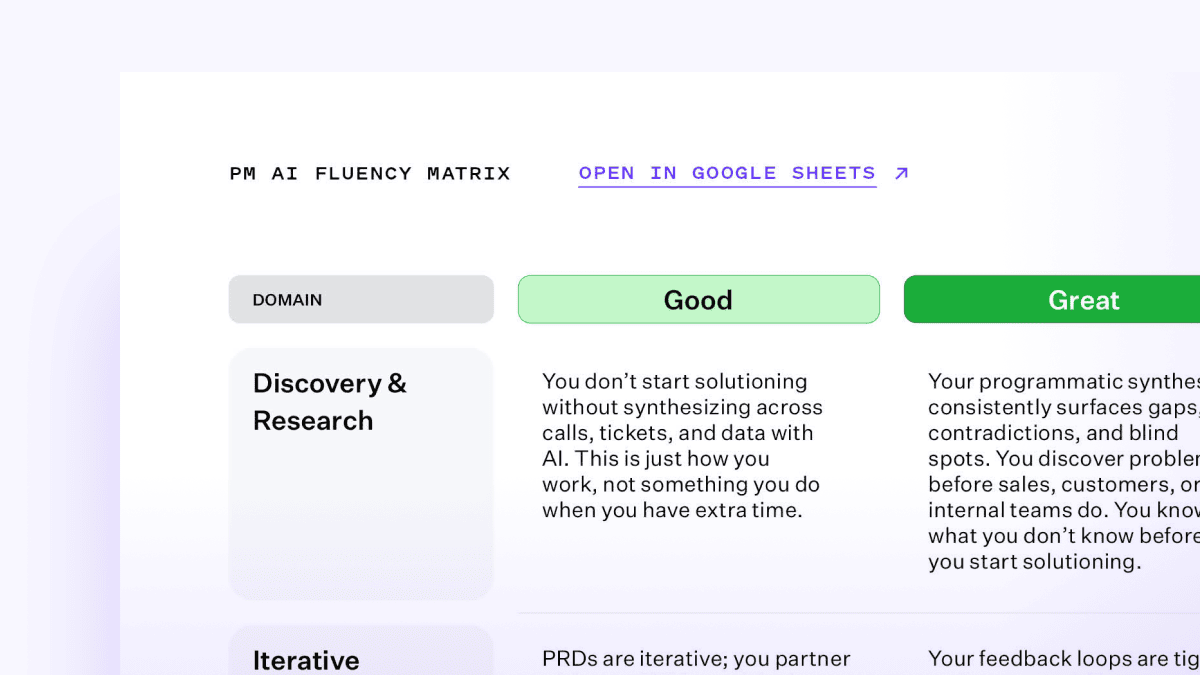
Within each domain, three tiers define what progress looks like: Good, Great, and Transformative.
Good means AI is your default operating mode across your whole PM practice. Even hitting the ‘good’ level is worth celebrating. After all, a PM hitting ‘Good ‘ across most domains has genuinely changed how they work.
Great means AI has measurably changed the quality of your decisions and outputs, and you've created reusable systems and processes that increase your team's efficiency, not just your own.
Transformative means you think AI-first about team, department, and customer problems: building tools, identifying where AI solves problems proactively, and compounding your team's speed permanently.
No one on Allison’s team is currently Transformative in all areas. The Matrix is designed to help PMs and their managers identify where growth makes sense, set goals with real success criteria, and have honest conversations about where they are and where they're headed.
There's a debate happening in the product community right now about whether the PM role is losing value in an AI-driven world. Allison believes the opposite: the PM craft is becoming more essential. The PMs who understand how to use AI to amplify their judgment are going to define what great product management looks like for the next decade.
The spirit behind sharing the Matrix externally is simple: no gatekeeping. If this framework helps PMs at other companies find their footing, have better conversations with their managers, or raise the bar for what they expect from themselves, that's a good outcome for the whole industry.
The Matrix is available as a downloadable PDF, which includes a link to an editable Google Sheets version you can adapt for your team.
The way great product teams operate is changing faster than most organizations can keep up with. The PM AI Fluency Matrix is Wrapbook's attempt to name what "good" looks like right now. It’s not a final answer, but a starting point for the conversations that help teams get there.
If you're a PM, a product leader, or anyone thinking about how to build in the age of AI, we hope it's useful. Take it, remix it, and make it your own.
Five years ago, a product manager's core toolkit looked roughly the same as it had ten years before that: discovery sessions, PRDs, stakeholder alignment, shipping. The fundamentals were stable; getting good at the job meant getting good at those fundamentals.
But that was before AI.
Of course, the essential attributes that make a PM great haven’t changed. Sharp judgement, obsession with the customer, a relentless approach to problem-solving are still the whole ballgame. But in the era of AI, the ceiling on what a great PM can accomplish has risen dramatically. And with it, the floor of what's expected has shifted, too.
At Wrapbook, we've seen this firsthand. Over the past year, our product team has shipped 60% more pull requests. That kind of acceleration doesn't come from working harder; it comes from working in a fundamentally different way.
Allison Takeuchi, Wrapbook's Chief Product Officer, has spent the last year living inside that shift: delivering PRDs through Claude, automating pieces of the product development lifecycle alongside her PMs, and sorting what actually moves the needle from what's just noise. Those experiences led her to create the PM AI Fluency Matrix.
Initially created for her own team, Allison’s PM AI Fluency Matrix is a shared vocabulary for what AI fluency looks like in practice. Because while at this point, it’s a given that her team will be using AI, what really matters is impact. How do the best PMs turn these tools into sharper decisions, more efficient systems, and better outcomes for their teams and customers? That’s what the Matrix is designed to capture.
The Matrix is organized around six core domains of the PM craft: