Join the Crew
Get the best resources for producers delivered to your mailbox

Get the best resources for producers delivered to your mailbox


The Wrapbook Team consists of individuals who are thrilled about building modern software tools for creators. We’re a team of compassionate and curious people dedicated to solving complex problems with sophisticated solutions. You can find us across the U.S. and Canada.
At Wrapbook, we pride ourselves on providing outstanding free resources to producers and their crews, but this post is for informational purposes only as of the date above. The content on our website is not intended to provide and should not be relied on for legal, accounting, or tax advice. You should consult with your own legal, accounting, or tax advisors to determine how this general information may apply to your specific circumstances.
Add up the hours your team spends on the small stuff. Account coding, reconciliation, approval-chasing, data entry. Individually, none of it takes long. Together, those small tasks can eat an entire day.
The answer is automating the small, repetitive tasks so you have the bandwidth to focus on the big stuff.
You’ve probably typed “see attached” into an email and hit send without attaching anything. Except your email didn’t let you. A little prompt popped up first: “Did you mean to attach a file?” One small alert, and the mistake never leaves your outbox.
Onboarding should work the same way: too often, a missing form only surfaces when payroll is due, after days of chasing signatures. With Wrapbook, crew e-sign their documents right in the platform, and real-time compliance alerts point you to anything missing, so you catch gaps while they’re still easy to fix.
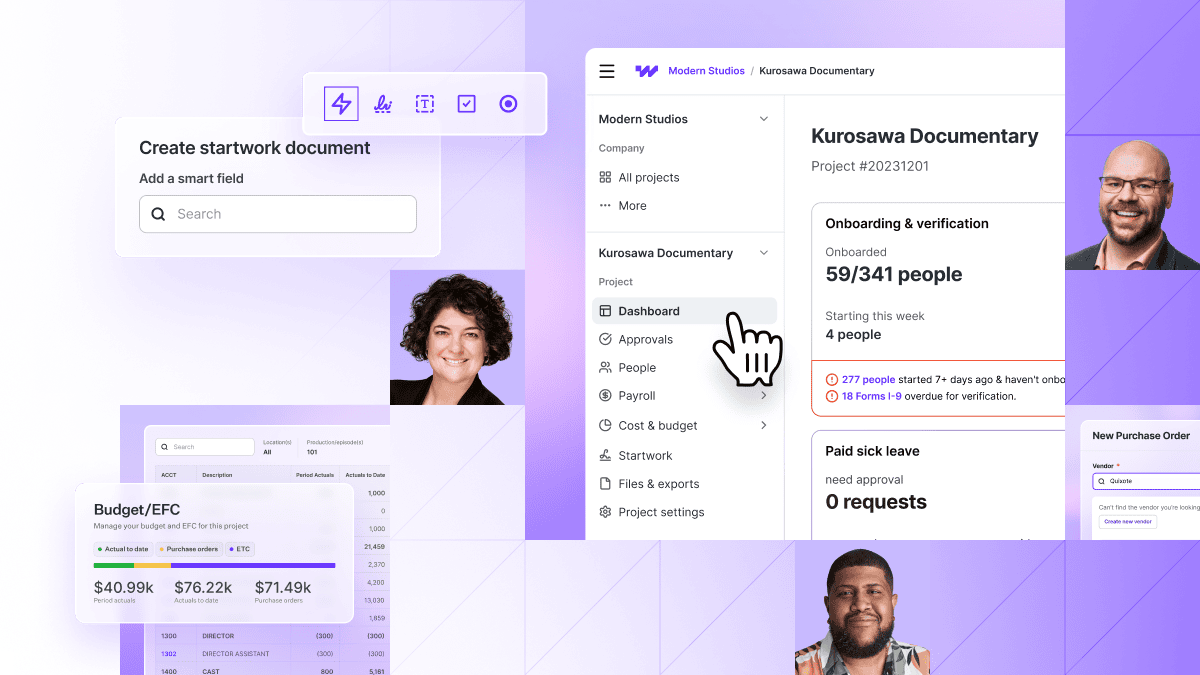
Plus, smart startwork keeps things moving quickly: upload and customize startwork in seconds, save your go-to packets for reuse, and let smart fields fill in worker information automatically. That’s what you should expect of a modern platform: quick, compliant onboarding, with a safety net that catches what you’d otherwise miss.
Invoice entry is one of those jobs that seems small until you're forty invoices deep at 9 p.m., keying vendor names and dollar amounts and hoping you didn't transpose a number.
You already know it doesn't have to work this way. Snap a photo of a check and your bank reads the amount, the account number, all of it. A truly modern finance app should be able to do that for your invoices. With Wrapbook, for example, all you have to do is drop an invoice in. AI reads it, pulls the data, and imports it straight into your GL. You review, you approve, and you're done.
New vendor? Upload a W-9 and Wrapbook adds the vendor to your system automatically. It flags duplicate vendors so you can consolidate them, and it verifies each vendor's tax ID for you, so it's your first line of defense against fraudulent vendors making their way onto your books.
“This has been such a cool addition. Invoice processing is noticeably simpler.”
Ciria Cordero, Director of Finance, Mark Wahlberg's Unrealistic Ideas
When you want to adjust a permission, reroute an approval, or reshape a report, most platforms make you call up a rep on the phone. But a modern platform should hand you the keys. With Wrapbook, you set access, build approval flows, and shape your reports yourself, in the app, in a few clicks. No back-and-forth emails trying to describe exactly what you want, and no slowing down production over what should be simple adjustments.
“The ability to take control, to take ownership of the project: that alone saves us at least one to two weeks on pre-pro.”
Asao Trinh Tate, Accounting Controller, Magilla Entertainment
Same goes for permissions: it shouldn’t require a phone call. With Wrapbook, you set access yourself, in the app, in a few clicks.
And you can get precise. Start from Wrapbook's built-in role templates and fine-tune them down to the detail, giving each person exactly the access they need by company, by project, or by department. Save your custom permissions once and reuse them across every project instead of rebuilding the same setup each time.
You've probably set up rules in your email so certain messages route themselves: flagged as important, filed in the right folder, or pushed to the top of your inbox. You defined the logic once, and now it runs without you.
Wrapbook brings that same idea to approvals. Build reusable flows that send each request to the right people in the right order, automatically. Track every approval in the app, so you can always see where something is sitting and who it's waiting on. And set conditional rules for the cases that call for them, like requiring an extra sign-off once an expense crosses a certain dollar threshold, without slowing down everything else.
Customizing a report should take seconds, so why does it so frequently require multiple calls with support, and custom builds every time you want a slightly different view? In Wrapbook, you select columns you need, hide the ones you don't, and save the layout for next time, right in the app.
You can also create and adjust report templates yourself. That means no hours on the phone getting things tweaked, and no scrolling through 15 nearly identical cost report templates to find the one you need.
Nobody wants to find out they're over budget after the money's already spent. But piecing together an accurate picture of spend often means shuffling between systems: one for payroll, one for AP, one for accounting. Even when those systems technically live under the same roof, they don't talk to each other.
It gets old fast. A modern finance platform should give you the full picture in real time, with no piecing data together or waiting on someone else to pull it for you.
“If I want to see the audit trail, if I want to see where someone's timecard is, it's just there. Everything's so easy to find. It's not a ten-step process.”
Christ Vokos, Head of Television, Ten-Key Accounting
When you search your inbox, you don't need to remember what day an email was sent or the sender's exact address. You type a few keywords and your app finds it, even across multiple accounts at once.
Wrapbook brings that same idea to your GL, so you can search across all your projects at once. Type what you're looking for in plain language, and the answer comes back in seconds. No switching between projects, no trying to remember where something might be.
Seeing your data clearly shouldn't stop at the edge of one platform. You need the full picture inside the platform, but you need to be able to get your data back out just as easily, into the other systems your finance team already runs on, like:
With a modern platform, you should expect seamless integrations with these kinds of tools. Your numbers should be current both in your finance platform and in your books at the same time, without the exporting and re-keying that can lead to errors and reconciliation headaches. You get one source of truth instead of two that drift apart, and you keep the accounting setup your team already trusts.
The teams that expect more from their software get more back: hours returned to the work that matters, and room to take on bigger, bolder projects.
Your finance software should be in your corner. It's time to expect more from it.
These days, production is asking more of finance teams than ever. Budgets are tighter, timelines are shorter, and the same small team is often juggling payroll, AP, and accounting across multiple projects at once.
In that environment, the teams pulling ahead are the ones who have the right tools. And when it comes to software, it’s essential that finance teams stop settling for the status quo and start expecting more. The good news? ‘More’ is already here.
So what should a truly modern finance platform be doing for you? Three things:
Put those together and your finance team has room to think bigger. You say yes to the extra project. You take on the accelerated shooting schedule. And you start accomplishing more in less time, with tools that are in your corner, not in your way.
But what do those tools actually look like in practice?