Join the Crew
Get the best resources for producers delivered to your mailbox

Get the best resources for producers delivered to your mailbox


Tom is a filmmaker, producer, and marketing specialist based in Los Angeles.
At Wrapbook, we pride ourselves on providing outstanding free resources to producers and their crews, but this post is for informational purposes only as of the date above. The content on our website is not intended to provide and should not be relied on for legal, accounting, or tax advice. You should consult with your own legal, accounting, or tax advisors to determine how this general information may apply to your specific circumstances.
Fringes are not static; rates change all the time. And fringe changes touch every kind of production. The pace of commercial work, though, makes the important work of tracking changes to fringe rates uniquely challenging.
First, timelines are compressed. A commercial can go from bid to shoot day in a few weeks, which leaves little room to double-check rates in between. Many production companies also run several jobs at once, so the rates from one estimate tend to get copied into the next.
Second, rate cycles don't line up. The SAG-AFTRA commercials contract runs April 1 through March 31, and the DGA commercial card runs December 1 through November 30.
Film and television agreements follow their own schedules, with SAG-AFTRA and DGA theatrical and television rates running July 1 through June 30.
A production team working across both commercial and film and television can easily apply the wrong rate, with significant consequences. SAG-AFTRA's commercial P&H rate is 23.5% against 22% for theatrical and television, for example, and the DGA's commercial rate is 20.5% against 22.25% for film and television.
Applying a theatrical or television fringe to a commercial bid, or the reverse, may seem like a small mistake, but it carries a real price tag.
Third, jobs that straddle an effective date can change the applicable rate partway through. A shoot that crosses a contract reset, or a campaign that shifts from standard use to digital-only, may land on a different rate than the one you bid.
A stale fringe rate rarely announces itself. Instead, it shows up later as a number that doesn't reconcile. Here are the four places where outdated fringe rates tend to surface and cause issues.
Fringes underestimated on the AICP bid usually get absorbed by the production company.
The math adds up quickly. Budgeting the 22% television rate on a commercial that carries 23.5% leaves $1,500 uncovered on every $100,000 of covered earnings. Budgeting the standard 23.5% on a job that turns out to be digital-only at 40% leaves $16,500 uncovered on the same amount.
Under cost-plus arrangements, fringe calculations are reviewed line by line. A mismatch between your rate and the contract rate invites more questions, and it can undermine your credibility with the agency across the rest of the cost report.
Accountants end up reworking numbers that should have been right from the start. Each correction means revisiting the budget, timecards, and the cost report, usually while the team is trying to close the books.
As our fringe mapping guide explains, errors are far easier to fix during production than after wrap.
Under-reported P&H can lead to plan notices, back payments, and talent relations problems.
These notices arrive after the shoot, when the money has already been spent, and a shortfall in P&H touches the people who worked on your set directly.
The fix for outdated fringe rates starts where the numbers live.
Fringe data works best when it’s held in a single reference source: clearly dated, current, and open to both the producer bidding the job and the accountant closing it.
In practice, that means anyone on the team can see which contract and which effective dates a rate belongs to, and can trust that it has been updated since the last reset. The producer pulls the same figure that the accountant will check at wrap, so the estimate and the reconciliation start from the same place.
Compare that with the usual setup: PDFs buried in email threads, bookmarked union websites, and last year's bid template with last year's percentages baked in. Each disconnected source lives separately. Taken together, they can leave the team guessing which rate is current.
That is the gap Wrapbook's Rate Finder is built to close. Commercial fringes now live in the Rate Finder’s Fringe Finder, alongside film and television fringes, bringing all of Wrapbook’s fringe data into a single, unified point of reference.
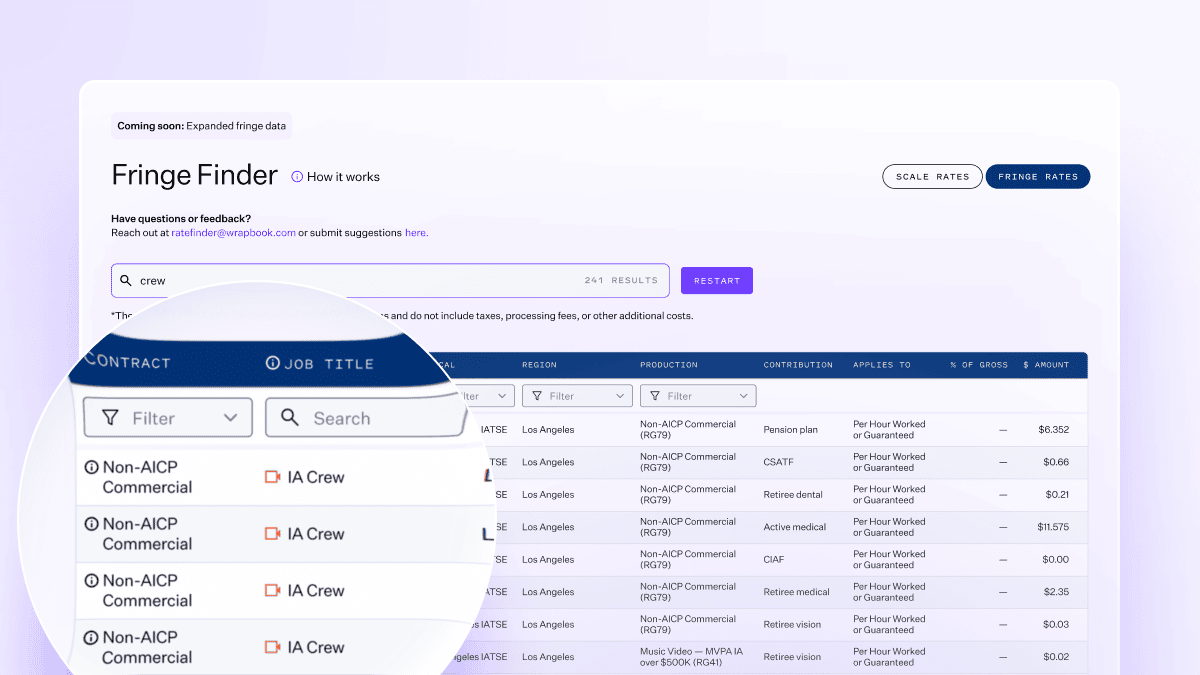
Wrapbook’s Rate Finder carries commercial scale rates for DGA, SAG-AFTRA, and IATSE roles. Use the Rate Finder to pull accurate, up-to-date scale rates, then the Fringe Finder to confirm all of the fringes that sit on top.
As with any budgeting reference, the Rate Finder works alongside the union agreements themselves, so confirm final terms against the agreements before you commit to a bid.
Whether you're bidding a national spot, a regional campaign, or a branded content series, having accurate fringe rates protects your margin, your credibility with the agency, and your relationships with the people on set.
To put the right numbers in your next estimate, explore Wrapbook’s Rate Finder and run your labor costs through the Payroll Estimator.
For the fundamentals behind the numbers, check out our guides to fringe mapping, the DGA rate card, and SAG-AFTRA rates.
A commercial can move from bid to wrap in a matter of weeks, and somewhere in that sprint, a handful of fringes may decide whether the job makes money.
Fringes are easy to get wrong. Union contracts reset on their own calendars, payroll taxes vary by state, and the fringes on last quarter's job may not be the same as on this one. When the clock is ticking, having accurate fringe rates at your fingertips can make all the difference.
In this guide, we're breaking down what commercial fringes are, why rate changes hit commercial work harder, where outdated rates cost you, and what a reliable fringe reference looks like in practice.
Fringes are the costs an employer pays on top of gross wages.
You can think of a fringe rate as the total cost of benefits and fees a production must cover on top of gross wages, expressed as a percentage of those wages.
For commercial production, fringes can generally be bucketed into four groups: union benefits, such as pension, health, and welfare contributions; payroll taxes; workers’ compensation insurance; and handling and agency fees.
Union benefits apply to the wages of every union member. They’re generally a set amount per hour or per day worked, and the amount varies by union and work location.
If your production company is an AICP member that has signed on to the Producers’ Health Benefits Plan (PHBP), then these contributions will be included in your final fringe rate. The contribution is for commercials only and is levied at a set amount per person per day.
Payroll taxes cover Social Security, Medicare, and federal and state unemployment insurance. Rates and cutoffs vary dramatically from state to state, and state unemployment rates and maximums can change from year to year.
They apply to employees only, not to independent contractors or loan-outs. Our guide to calculating payroll taxes covers the basics.
Workers’ comp insurance covers every worker on a production and is generally paid as a set percentage of wages. Rates can vary widely based on production location, role, and even the size of your payroll.
Handling and agency fees include payroll processing fees, plus any handling or agency-related charges that come with how you pay your crew.
Fringes that fall into any of these four categories can be expressed in different ways. A fringe can be a percentage of gross, a flat hourly amount, or a percentage with a ceiling, and every fringe carries its own effective dates.
To learn more about how fringes, with all of their component costs, get coded into a budget, check out our guide to fringe mapping basics.