Join the Crew
Get the best resources for producers delivered to your mailbox

Get the best resources for producers delivered to your mailbox


The Wrapbook Team consists of individuals who are thrilled about building modern software tools for creators. We’re a team of compassionate and curious people dedicated to solving complex problems with sophisticated solutions. You can find us across the U.S. and Canada.
At Wrapbook, we pride ourselves on providing outstanding free resources to producers and their crews, but this post is for informational purposes only as of the date above. The content on our website is not intended to provide and should not be relied on for legal, accounting, or tax advice. You should consult with your own legal, accounting, or tax advisors to determine how this general information may apply to your specific circumstances.
Welcome, Ali, and thanks for joining us today for this exclusive NPACT interview.
To get us started and set the stage for the topics we’ll explore today, I’d love to hear how you’d summarize Wrapbook—your “elevator pitch,” if you will, about what Wrapbook is and what sets you apart.
Thanks for having us—we’re big fans of the work NPACT does and thrilled to be here.
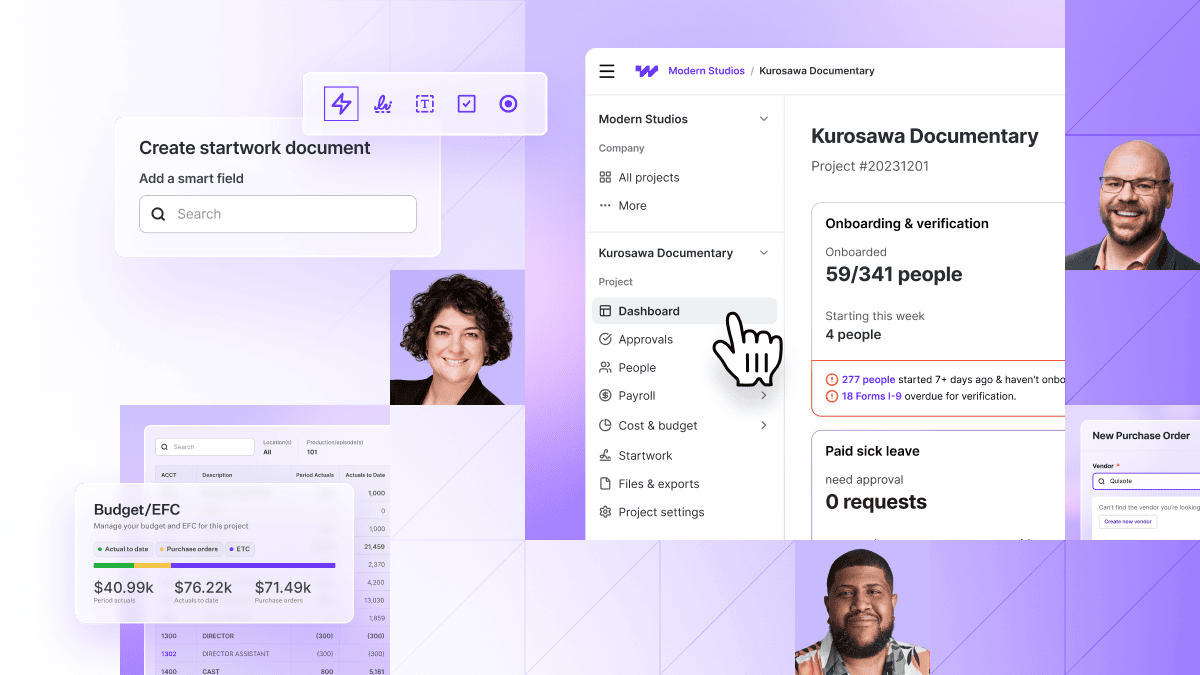
Wrapbook is the AI platform built for production finance teams. We unify payroll, production accounting, and accounts payable in one place. With technology powered by AI and concierge support from veteran paymasters, Wrapbook empowers productions to move faster, work smarter, and do more with less.
As we’re all experiencing, the entertainment landscape continues to evolve rapidly in every aspect—from fluctuations in buyer demand, evolving monetization models, shifting budget parameters, to the introduction of AI. How do you see these shifts influencing the financial and operational backbone of production, and where do you see the biggest opportunities for modernization?
Fewer projects are being greenlit, and when they are, productions face intense pressure to do more with less. In the end, a lot of that pressure falls on finance teams. Budgets are tighter, timelines are shorter, and financing models are more complex—yet the systems supporting production finance haven’t evolved to keep up.
We’re most proud when we see our customers switch to Wrapbook, and immediately begin expanding their slate of production—working more efficiently on more ambitious projects.
This transformation happens when accountants move from brute-force workflows—manually entering invoices, pulling reports, and running ad hoc analyses—to using a single unified platform where they can seamlessly pay people and vendors, and instantly access any information they need.
It not only lets them move faster, it gives studios greater confidence in working with them.
As the Wrapbook platform evolves into a broader financial infrastructure for production, how would you define Wrapbook’s role in this next phase?
The past few years have seen massive transformations in our industry.
COVID created an insatiable demand for content while forcing a shift to digital workflows. A few years after that, labor actions across the major unions disrupted production pipelines. And today, studios are facing increased pressure to scale back production and tighten budgets.
That’s why AI is already beginning to reshape how studios and production companies operate. And the old way—manually reconciling cost reports to answer a simple question—won’t meet expectations in the future.
Wrapbook exists to help accountants, producers, finance executives, and production companies accelerate their work with AI and keep pace with where the industry is headed.
Today, Wrapbook’s AI can automatically reconcile accounts payable and answer spend questions instantly. And we’re only getting started.
In the months and years to come, accountants who lean into AI adoption will be in higher demand, and production companies that embrace these tools will become more efficient, more profitable, and win more projects.
Wrapbook offers a concierge level of support, meeting accountants and companies where they are and helping them evolve iteratively.
Our goal is simple: help our clients grow so we can grow with them.
Wrapbook recently announced a number of new Accounts Payable features. You describe this as part of what is moving the company “up the value chain.” Can you tell us more about that?
60% of production spend goes to vendor payments—yet legacy systems are broken. They’re inefficient, prone to fraud, and lack the controls modern businesses require.
The problems are obvious once you step back and look at them:
Wrapbook streamlines the entire payables workflow with:
Why bring spend, vendor payments, and accounting under one roof—and what will a day in the life look like for a production using this “one system” platform?
Anyone who’s worked on a production knows how fragmented the process is. Timecards live in one system, invoices in another. Approvals happen in email threads, and cost reports live in spreadsheets that don’t always align. Teams lose countless hours reconciling data instead of doing high-level strategic work.
With everything in one platform, that changes. When a timecard is approved or an invoice comes in, it automatically flows into the same financial record as everything else. Accountants see real-time costs, producers can check budget-to-actuals instantly, and approvals happen in one click – not endless email chains.
It’s a completely different way of working. Everyone operates from the same data, which means faster wraps, fewer surprises, and a clearer view of spend—freeing up teams to focus on making great work, not chasing paperwork.
Financial transparency and accountability are, of course, key. How is Wrapbook ensuring trust and accountability as it provides more tools and options for moving and managing production money?
Trust is the foundation of everything we do. When you’re moving real production dollars—whether it’s payroll, vendor payments, or reimbursements—there’s no room for uncertainty. From day one, we’ve focused on giving productions full visibility into how every dollar moves, while ensuring every transaction is secure and auditable.
Our foundation of trust is built on two pillars; the first is control. Every payment and approval in Wrapbook is traceable, so teams always know who did what and when. Permissions and workflows can mirror how each production actually operates, meaning accountability is built in.
The second pillar is visibility. We designed Wrapbook so everyone—from accountants to producers to executives—can see exactly what they need to do their jobs. Every dollar is tracked, verified, and transparent.
Ultimately, our goal is to help productions move money faster—with total confidence that everything is accurate, compliant, and secure.
In this era of automation and AI, how do you balance intelligent systems with the human expertise that’s so crucial in our industry?
Our view on AI is simple: it’s a force multiplier. It makes teams faster and more capable—it doesn’t replace the people who understand production finance inside and out.
Productions succeed because of people—people making smart, fast decisions under pressure. No system replaces that experience or instinct. What technology can do is remove the noise, giving those people more leverage to focus on what matters.
At Wrapbook, we combine powerful automation with concierge service from industry veterans. AI handles the manual lifting—reading invoices, flagging issues, syncing data—while experienced paymasters and accountants work alongside your team.
Wrapbook empowers humans to do more in less time, more easily.
The entertainment industry has always moved in cycles, but as of late, those cycles have tightened. Labor disruptions, budget pressures, and the rapid emergence of AI have fundamentally changed what it takes to bring content to life.
When NPACT sat down with Wrapbook Co-Founder & CEO Ali Javid, the conversation centered on a growing tension: production finance and accounting teams are being asked to keep up with unprecedented change—often without the infrastructure they need. The industry is accelerating, and these teams are the ones expected to absorb the shock.
As Javid explained, fewer projects are being greenlit, and those that do move forward come with tighter budgets, shorter timelines, and increasingly complex financing structures. The result? Finance and accounting teams are being asked to do more with less—without the systems to support them.
For years, production accounting has relied on fragmented systems and manual workarounds. Timecards in one place, invoices in another, approvals in email, cost reports in spreadsheets—it’s a workflow that reflects legacy systems more than the efficiency modern productions now require.
Another major takeaway from the conversation was how recent industry disruptions have exposed the limits of older workflows. COVID pushed productions online almost overnight. Union actions reshaped schedules and timelines. Studios are under mounting pressure to cut costs and make faster decisions. And now AI is raising expectations around speed, accuracy, and insight.
The traditional approach—manually reconciling AP, chasing receipts, processing invoices line by line—is at risk of slowing teams down and putting added strain on finance departments already stretched thin. What the industry needs now is a steadier operational backbone, one built for speed, clarity, and resilience.
In that context, AI isn’t a novelty. It’s just one sign of a larger shift underway—a signal that productions can no longer rely on fragmented tools and manual workflows to meet the demands of modern schedules and budgets. To fully benefit from AI, and to operate with the pace the industry now requires, productions need something more foundational: a unified system that brings their financial operations into one place.
As Javid explained in the interview, bringing production payroll, accounting, and AP into one system unlocks immediate benefits. Accountants gain real-time actuals, producers get instant budget visibility, executives see a clearer financial picture, wraps move faster, errors shrink, and trust grows across the entire production.
It’s a fundamentally different way of working—one that aligns with the speed, transparency, and accountability modern productions now require.
In the interview, Javid noted that this unified approach is already reshaping how many productions work day to day. Instead of juggling separate tools or exporting files between systems, with Wrapbook, teams can manage payroll, vendor onboarding, accounts payable, and cost tracking in the same workflow. Vendor validation, native payments, and automatic reconciliation streamline processes that once took hours, giving productions a clearer, faster path to managing spend.
But unification on its own isn’t enough. As budgets tighten and timelines compress, teams also need tools that help them work smarter. That’s where AI makes an immediate difference: reconciling data automatically, catching issues earlier, and reducing the manual lift that slows productions down. It can read invoices, flag discrepancies, and keep information synced—freeing teams from hours of repetitive work.
Javid also shared examples of how Wrapbook’s AI is already working behind the scenes for productions—reading invoices, matching them to POs, surfacing discrepancies early, and keeping data synced so the accounting team can stay ahead of potential issues rather than react to them late in the cycle.
And importantly, this technology doesn’t operate in a vacuum. Experienced paymasters and accountants work alongside your team, pairing their production expertise with the efficiency gains AI provides.
Importantly, none of this replaces human expertise. As Javid emphasized, AI is a force multiplier—not a substitute for the accountants who guide a production’s financial reality. Automation handles the repetitive work; people apply judgment, experience, and strategy.
Together, a unified system and AI-driven support create a stronger operational backbone—one that helps productions move faster, operate with greater confidence, and stay resilient in a demanding landscape.
Any conversation about financial modernization in production must grapple with a core reality: production money requires absolute trust.
Javid highlighted two principles essential to building that trust:
Accountants, producers, and executives each require the right financial information at the right time—not hidden in spreadsheets or scattered communications, but available instantly.
As Javid pointed out, these principles shape how Wrapbook approaches financial operations. Every payment, approval, and vendor action in the system is fully traceable, and real-time visibility ensures accountants, producers, and executives are working from the same information. The goal is not just speed, but confidence—confidence that every dollar is accounted for and every workflow mirrors the way productions truly operate.
As the industry embraces more automation, these human-centered controls become even more critical.Despite increasing automation, Javid was unequivocal: people remain the core of production finance.
Teams succeed because of experienced accountants and producers who can interpret data, solve problems, and guide productions through uncertainty. Any modern platform—AI-powered or otherwise—must support that expertise, not overshadow it.
The NPACT interview underscored a shift the entire industry is feeling. Production finance is being reshaped by economic pressure, technological advances, and rising expectations for speed and precision.
The coming decade will belong to production teams that embrace modernization—not to replace the human element of production finance, but to unlock its full potential.
And while Wrapbook is one of the companies building toward that future, the broader message stands: the industry is ready for a new operational backbone, and unified, modern financial infrastructure will be essential to delivering it.
For a closer look at how productions can streamline AP and strengthen their financial operations, Wrapbook’s AP Command Center offers a clear roadmap. It shows how teams can bring vendor onboarding, payments, and oversight into the same efficient workflow.
It’s an evolution rooted not in disruption for disruption’s sake, but in the belief that better infrastructure empowers productions to operate with more clarity, confidence, and creative freedom.
You can read the full interview below.