
Join the Crew
Get the best resources for producers delivered to your mailbox

Get the best resources for producers delivered to your mailbox


Tom is a filmmaker, producer, and marketing specialist based in Los Angeles.
At Wrapbook, we pride ourselves on providing outstanding free resources to producers and their crews, but this post is for informational purposes only as of the date above. The content on our website is not intended to provide and should not be relied on for legal, accounting, or tax advice. You should consult with your own legal, accounting, or tax advisors to determine how this general information may apply to your specific circumstances.
Wisconsin is one of the most geographically diverse states in the Upper Midwest and its range translates directly to the screen.
Nicknamed "the place where waters gather," Wisconsin is home to over 15,000 lakes, along with winding rivers, dense pine forests, rolling farmland, and picturesque cities.
For filmmakers, that means an impressive range of production-ready locations capable of supporting everything from intimate character dramas and period pieces to action films, holiday movies, and unscripted television.
Door County, sometimes called the "Cape Cod of the Midwest," offers scenic coastal bluffs, cherry orchards, and quaint harbors.
The Northwoods region, blanketing the northern third of the state, delivers deep forest isolation ideal for thriller, horror, or nature-driven storytelling.
Meanwhile, the brick-and-steel industrial character of Milwaukee and the college-town energy of Madison provide an unmistakably authentic urban texture.
Wisconsin's versatility has helped attract productions ranging from Public Enemies and Bridesmaids to the cult hit Hundreds of Beavers. More recently, the holiday feature A Cherry Pie Christmas showcased Door County's storybook charm, while Bravo's Top Chef selected Milwaukee as the backdrop for Season 21.
But locations are only part of the story.
Productions are also drawn by the fresh, underrepresented regional stories Wisconsin enables. Heartland imagery, Great Lakes culture, and post-industrial narratives all contribute to a sense of authenticity that can be difficult to replicate elsewhere.
Wisconsin's production infrastructure is growing quickly, too. With the launch of Film Wisconsin, producers now have access to dedicated support for location scouting, permitting, workforce development, and production logistics.
And of course, one of the biggest reasons producers are taking a fresh look at Wisconsin is the return of statewide production incentives.
Under Governor Jim Doyle, Wisconsin enacted its first film tax incentive program in 2006, designed to catalyze the local film economy and attract productions that might otherwise bypass the state.
The program ran for only five years. In 2011, Wisconsin chose to eliminate both the tax credit and its dedicated film office, leaving the state without an incentive for more than a decade.
Industry advocates, local filmmakers, and production professionals consistently pointed to the lack of statewide production incentives as a barrier to growing Wisconsin's creative economy. As neighboring states continued investing in their own programs, pressure mounted for Wisconsin to reestablish a competitive production incentive.
Then, in 2025, lawmakers in the Badger State officially revived Wisconsin film incentives, creating a new state film office to administer not one but two new film tax credit programs.
Wisconsin film incentives now operate through two distinct programs: one designed to attract production spending and another focused on encouraging long-term infrastructure investment.
The result is a more comprehensive Wisconsin film tax incentive strategy aimed not only at bringing productions to the state today, but also at building the foundation for a stronger and more sustainable Wisconsin film industry in the years ahead.
So what do Wisconsin film incentives look like today? Let's take a closer look…
Today, Wisconsin administers two distinct production incentives through Film Wisconsin, the state's newly established film office.
Together, these programs are designed to support both immediate production activity and long-term industry growth within the state.
The Film Production Services Tax Credit is the primary Wisconsin film tax credit for film, television, commercial, and digital media productions.
Under the program, qualified productions can receive a 30% transferable tax credit on eligible in-state expenditures. The program is funded at $5 million annually and provides a maximum credit of $1 million per applicant.
To qualify for this Wisconsin film tax incentive, productions longer than 30 minutes must incur at least $100,000 in qualified Wisconsin expenditures. Projects under 30 minutes, such as commercials and short films, must spend at least $50,000 in the state.
One of the most attractive features of the Wisconsin film tax credit is its transferability. Productions without Wisconsin tax liability can sell the credit to Wisconsin taxpayers, allowing out-of-state producers to monetize the incentive's value.
Additionally, Wisconsin now offers the Film Production Company Investment Tax Credit.
Rather than rewarding individual productions for spending in the state, the Film Production Company Investment Tax Credit encourages long-term investment in Wisconsin's production infrastructure.
This Wisconsin film tax credit provides a 30% credit on eligible investments made by film production companies establishing a physical presence in Wisconsin.
Qualifying expenditures include the purchase of production equipment and other depreciable property, as well as costs associated with acquiring, constructing, rehabilitating, remodeling, or repairing real property.
In practical terms, this Wisconsin film tax incentive is designed to encourage the development of studios, production facilities, post-production operations, and other permanent industry infrastructure.
Importantly, this credit is available only for costs incurred during the first three years a company operates as a film production company doing business in Wisconsin. It is not a recurring annual benefit but rather a one-time runway incentive for companies making a long-term commitment to the state.
One of the strengths of Wisconsin film incentives is their broad eligibility. The Film Production Services Tax Credit is available to a wide range of production types, including:
Not every production qualifies, however. The following project types are specifically excluded from the Wisconsin film tax credit program:
Notably, reality television and unscripted competition formats can qualify for Wisconsin film incentives. Commercials and documentaries are also eligible.
So what expenditures qualify for the Wisconsin film tax credit? And how much can productions expect to receive back in savings?
The good news is that Wisconsin film incentives make the answer relatively straightforward. Qualified productions can receive a 30% transferable tax credit on a broad range of in-state expenditures.
To better understand how the Wisconsin film tax credit applies to a production budget, it helps to think about qualified expenses in two categories: payroll and physical production spend.
Payroll is often one of the largest expenses on any production, and it represents a significant opportunity for savings under the Wisconsin film tax credit.
Productions can claim a 30% tax credit on qualified wages paid to cast and crew working in Wisconsin.
There is, however, a per-person compensation cap. Only the first $250,000 in wages paid to any individual cast or crew member qualifies for the credit.
This cap applies to both above-the-line and below-the-line personnel. For productions employing high-profile talent or highly compensated department heads, it's an important factor to consider when estimating the value of Wisconsin film incentives.
Beyond payroll, the Wisconsin film tax credit applies to a wide range of production expenditures incurred within the state.
Eligible expenses include:
The key throughline across all of these categories is Wisconsin origin: spending must flow through in-state vendors and service providers. Out-of-state purchases, even when used on a Wisconsin shoot, do not qualify for the Wisconsin film tax incentive.

Additionally, productions may claim a 100% credit on eligible Wisconsin sales and use taxes paid during production, creating an additional layer of savings beyond the standard Wisconsin film tax credit.
To successfully claim Wisconsin film tax credits, productions must meet several requirements designed to ensure meaningful economic activity flows into the state.
First and foremost, productions must meet the minimum in-state spend thresholds: $100,000 for projects longer than 30 minutes, and $50,000 for shorter projects.
Approval for Wisconsin film incentives is granted on a case-by-case basis. According to Film Wisconsin, priority consideration may be given to productions that support Wisconsin's creative workforce, showcase local communities, or generate broader economic benefits for the state.
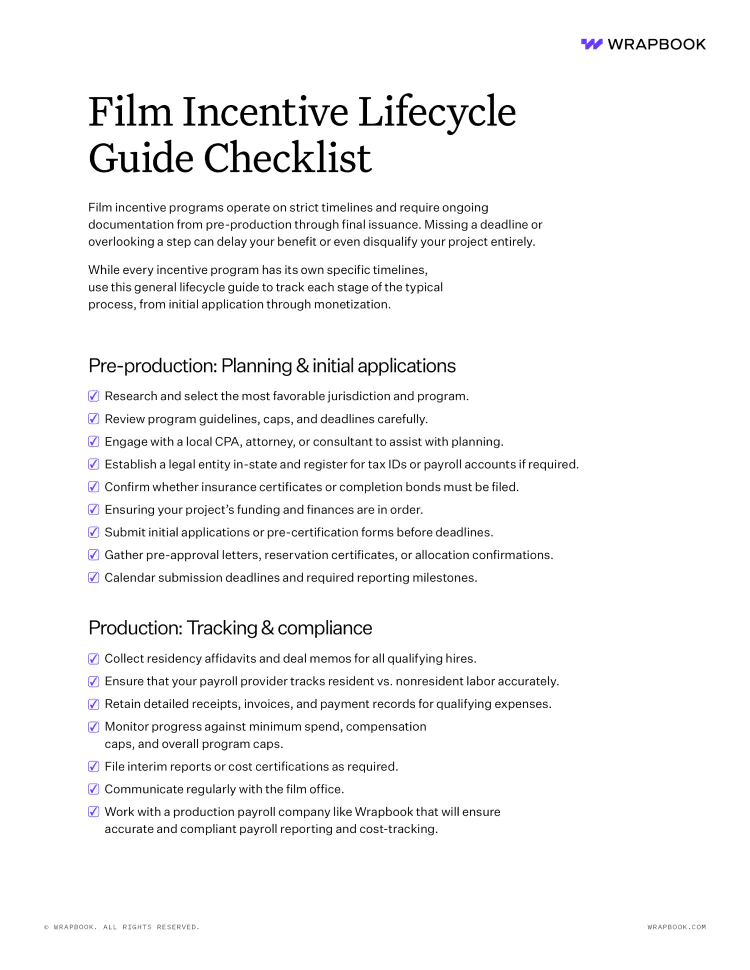
After production wraps, all final expenditures must be independently reviewed and verified by a Wisconsin-licensed Certified Public Accountant (CPA) before Film Wisconsin will issue a Tax Credit Certificate.
For companies pursuing the Film Production Company Investment Tax Credit, the key requirement is that the credit applies only during the first three years the business is operating as a film production company in Wisconsin.
Applying for Wisconsin film incentives is a relatively straightforward process administered by Film Wisconsin.
To begin, productions must submit an application and supporting documentation through the Film Wisconsin website. Film Wisconsin will review the submission and determine whether the proposed project meets the program's minimum requirements.
If approved, Film Wisconsin will issue the applicant a Tax Credit Accreditation Letter and schedule an implementation meeting with the production team. This meeting helps align expectations and ensures the production understands how to track and document qualifying expenditures throughout the shoot.
After production wraps, applicants must submit a final expenditures report prepared by a Wisconsin-based Certified Public Accountant (CPA) within 30 days of project completion.
Film Wisconsin will review the report and may request additional supporting documentation before issuing a Tax Credit Certificate. Once the Tax Credit Certificate has been issued, the production may claim the Wisconsin film tax credit through the Wisconsin Department of Revenue.
Because the Wisconsin film tax credit is transferable, productions without Wisconsin tax liability may also sell or assign the credit to another Wisconsin taxpayer. If a credit is assigned, the recipient must notify the Wisconsin Department of Revenue within 30 days of the transfer.
Film Wisconsin serves as the official state film office for the Badger State.
Officially launched in early 2026, Film Wisconsin was created to recruit productions, support local job growth, and administer the state's new Wisconsin film tax credit programs.
Beyond administering Wisconsin film incentives, Film Wisconsin acts as a production liaison for filmmakers working throughout the state. The office provides assistance with location scouting, permitting, workforce development, and connections to local crew and vendors.
In addition to statewide support through Film Wisconsin, producers filming in northwestern Wisconsin may benefit from resources offered by the Upper Midwest Film Office (UMFO).
Serving communities throughout the Upper Midwest region, UMFO provides production support, location assistance, and local industry connections that can help streamline filming in and around Wisconsin's northwestern counties.
For projects working near the Minnesota border, the organization can serve as a powerful production ally, helping productions navigate all of the resources and support available across the region.
Yes! In addition to statewide Wisconsin film incentives, certain local jurisdictions offer their own programs designed to encourage production spending at the municipal level.
The City of Superior Production Incentive Program offers film, television, and commercial productions a 25% cash rebate on qualified local expenses including food, catering, and lodging.
To qualify, projects must commit to a minimum spend of $5,000 within Superior city limits and employ local service providers. The program’s annual funding allocation is currently $20,000 and qualified project types include films, television, series, documentaries and commercials.
For productions filming in the northwest corner of Wisconsin, this municipal rebate can stack on top of statewide Wisconsin film incentives to meaningfully boost overall savings.
Whether you're developing an independent feature, a documentary, a commercial campaign, or an episodic series, Wisconsin film tax incentives can help stretch your production budget further while providing access to one of the Midwest's most versatile filming destinations.
To learn more about Wisconsin film incentives and compare them against programs across the country, visit Wrapbook's Production Incentive Center. With tools like the State Incentive Map and Incentive Comparison Tool, it's easier than ever to identify the right incentive for your next production.
From Door County's cherry-orchard coastline to the golden plains of western Wisconsin, the Badger State offers filmmakers an open canvas that stretches far beyond the obvious.
And after more than a decade without a dedicated film incentive, Wisconsin is bolstering its creative industry with the creation of a new state film office and the launch of a revived Wisconsin film tax credit program.
In this guide, we're breaking down how this new Wisconsin film tax incentive works, which productions and expenditures qualify, and how to apply so your production budget can go further in America's Dairyland.
Before we get into the details of Wisconsin film incentives, let’s take a moment to explore Wrapbook's Production Incentive Center, your dedicated guide to all things production incentives.
The Production Incentive Center is a comprehensive hub designed to help producers research, compare, and navigate film tax credits, rebates, and grant programs across the United States.
With the State Incentive Map, you can research incentives by state in just a few clicks. Or use the Incentive Comparison Tool to see how Wisconsin film incentives stack up against programs across the Great Lakes region, in states such as Illinois, Minnesota, and Ohio.
Whether you're drilling down into specific caps and minimum spend requirements or using the Incentive Finder to search by project type, Wrapbook's Production Incentive Center makes it easy to find the right program for your next production.


