
Join the Crew
Get the best resources for producers delivered to your mailbox

Get the best resources for producers delivered to your mailbox


Tom is a filmmaker, producer, and marketing specialist based in Los Angeles.
At Wrapbook, we pride ourselves on providing outstanding free resources to producers and their crews, but this post is for informational purposes only as of the date above. The content on our website is not intended to provide and should not be relied on for legal, accounting, or tax advice. You should consult with your own legal, accounting, or tax advisors to determine how this general information may apply to your specific circumstances.
Maryland’s appeal as a filming destination is rooted in its extraordinary geographic range.
Within a relatively compact footprint, productions can access the Chesapeake Bay’s fishing towns and tidal marshes, the Blue Ridge Mountains in the west, the beaches of Ocean City, and the dense urban character of Baltimore.
That flexibility gives productions a genuine logistical advantage. Crews can minimize company moves while capturing a wide variety of looks without ever crossing state lines.
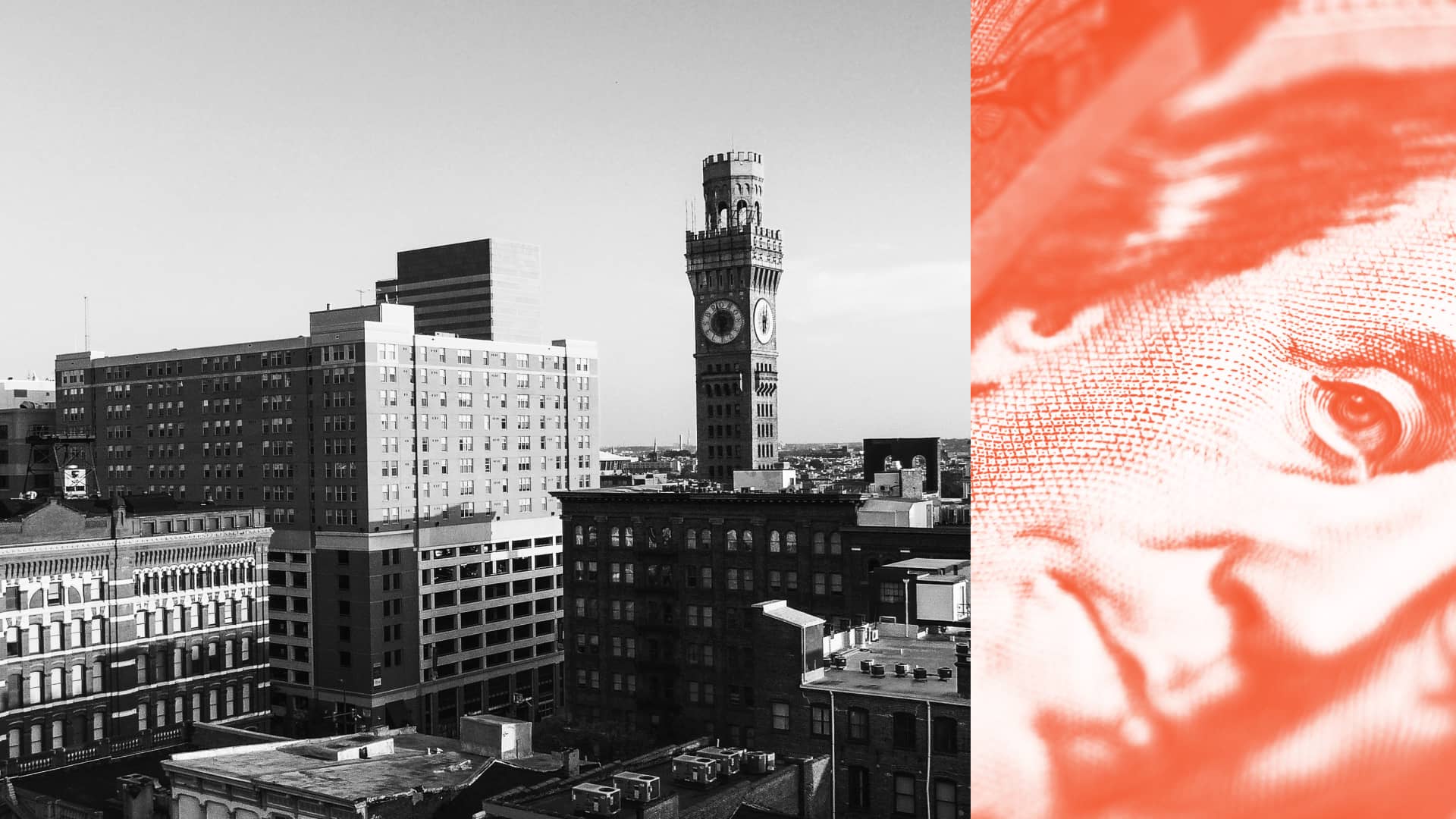
Baltimore, aka Charm City, remains one of the most visually distinctive production cities on the East Coast. Its industrial waterfronts, row houses, and historic neighborhoods can double for cities throughout the Northeast and beyond.

Historic Annapolis, with its colonial architecture and waterfront setting, is a period drama darling, regularly standing in for 18th-century England or early American settings. Meanwhile Prince George’s County, located just outside Washington D.C., has become a growing hub for studio infrastructure and sound stage development.
Maryland’s reputation as a production-friendly state is built on decades of iconic film and television production. The Wire, widely regarded as one of the greatest television dramas ever made, was shot entirely on location in Baltimore. Netflix’s House of Cards and HBO’s Veep also relied heavily on Maryland locations and local crews.
Modern film classics including The Blair Witch Project and Wedding Crashers, as well as recent favorites such as Charm City Kings and The Baltimorons have also all been shot in Maryland.
This rich production history has helped create one of the strongest crew bases on the East Coast. From above-the-line talent to experienced below-the-line technicians, Maryland’s film workforce has been forged by years of large-scale production.
Supporting it all is the Maryland Film Office, which assists productions with location scouting, permitting, crew resources, and administration of Maryland film incentives.
Maryland introduced its first major film incentive program in 2005 with the launch of a modest production rebate designed to attract more film and television projects to the state.
As competition between states intensified, lawmakers expanded the program in 2011 by creating the Maryland Film Production Activity Tax Credit. The updated program replaced the original rebate with refundable Maryland film tax incentives for feature films and television productions.
The program faced an important test just a few years later when major productions including House of Cards and Veep considered relocating to other states with more aggressive incentives. In response, Maryland lawmakers significantly increased program funding to help retain those productions and the thousands of jobs associated with them.
Since then, Maryland film incentives have continued to evolve. Funding allocations have steadily increased, and today Maryland film tax incentives rank among the more competitive programs in the Mid-Atlantic region.
Maryland film incentives come in the form of a refundable tax credit of up to 28% for feature films and up to 30% for television or streaming series.
Unlike transferable credits offered by some neighboring states, Maryland film tax incentives are fully refundable. That means productions do not need to sell or transfer the incentive to another company with in-state tax liability.
Instead, the state reimburses productions directly for the value of the Maryland film tax credit. This makes the Maryland film tax credit especially valuable for out-of-state production companies.
To qualify for Maryland film tax incentives, productions must spend at least $250,000 on qualified expenditures incurred in Maryland. Productions must also complete at least 50% of principal photography in Maryland.
Maryland film tax credits currently have a per-project cap of $10 million, meaning that $10 million is the most a single project can see returned through Maryland film tax incentives.
The program’s annual funding currently stands at $12 million per fiscal year and Maryland’s fiscal year runs from July 1 to June 30.
Maryland film tax incentives also include a special pathway for emerging and locally-rooted filmmakers: the Maryland Small Films designation.
Under the Maryland Small Films program, productions with at least $25,000 in qualified Maryland spending may apply for the Maryland film incentive program and earn a film tax credit of up to 28%.
Projects qualifying under Maryland Small Films are subject to a $125,000 project cap and must still complete at least 50% of principal photography in the state.
To qualify as a Maryland Small Film, the production company must:
The Maryland Film Office allocates 10% of annual Maryland film incentive funding specifically to Maryland Small Films.
A broad range of production types can take advantage of Maryland film incentives. Eligible projects include:
Notably, Maryland’s program extends to unscripted television, including reality programming, which some state programs exclude.

Because eligibility rules can evolve over time, producers should consult the Maryland Film Office directly before applying, to ensure their production can qualify for Maryland film tax credits.
Most production expenses including equipment rentals, location fees, props and wardrobe, along with cast and crew payroll, can qualify for Maryland film incentives, provided the spending is incurred in Maryland.
But how much can productions see returned through Maryland film tax incentives? Luckily, Maryland keeps the answer to that important question fairly simple and straightforward.
Compensation paid to both above-the-line and below-the-line Maryland residents and nonresidents, as well as physical production costs are eligible for Maryland film tax credits. Qualified feature film productions can earn a credit of up to 28% on eligible in-state spending and episodic television series can earn a credit of up to 30%.
Qualified expenditures include:
Wages paid through loan-out companies can also qualify, provided those companies are properly registered to do business in Maryland.
Qualified compensation payments to all cast and crew, both resident and nonresident and above-the-line and below-the-line, are subject to a compensation cap of $500,000 per individual. This means that only the first $500,000 paid to each individual will qualify toward the Maryland film tax credit.
In order to qualify for Maryland film tax credits, productions must satisfy several core program requirements.
First and foremost: productions must shoot at least 50% of their principal photography in Maryland and incur a minimum in-state spend of $250,000.

As mentioned earlier, projects applying as a Maryland Small Film must spend at least $25,000 in state. Credits for these productions are capped at a maximum of $125,000 per project.
Before approval, producers must submit a package of materials to the Maryland Film Office. This typically includes a detailed production budget, a shooting schedule, proof of financing, a breakdown of anticipated in-state spending, and other supporting documentation required by the Office.
After production wraps, projects must undergo a formal CPA audit of all qualified expenditures. The audit must be conducted by a Maryland-licensed certified public accountant and submitted to the Maryland Department of Commerce, which then reviews the findings before issuing the final credit certificate.
Maryland film incentives are awarded on a first-come, first-served basis.
Applying for Maryland film incentives starts with the Maryland Film Office, which manages the application process and provides all required documentation for the Film Production Activity Tax Credit.
Producers should engage the Office early—ideally in the early stages of pre-production—to understand current funding availability and ensure their project meets all eligibility criteria.
Applications must be submitted and approved before principal photography begins. Late applications will not be considered, so producers should build the incentive application timeline into their overall production schedule from the outset.
When submitting an application, producers must provide:
If approved, the Maryland Film Office issues an initial certification letter confirming eligibility for the Maryland film tax credit.
After production wraps, productions must submit final accounting documentation and complete the required CPA audit before the refundable credit is issued.
The Maryland Film Office serves as the Free State’s central hub for all things film and television production.
In addition to administering Maryland film incentives, the Office actively recruits productions to the state, assists with location scouting through its extensive online location library, and connects filmmakers with experienced local crew and vendors.
The Office also works closely with local film commissions throughout the state, including the Baltimore Film Office and Prince George’s Film Office. Whether you need help navigating a complex permit process in Baltimore’s historic districts or want to tap into Prince George’s County’s growing studio infrastructure, a network of Maryland film professionals stand ready to help.
Producers with questions about the Maryland film tax credit, eligibility requirements, or available locations should contact the Maryland Film Office directly.
Whether you’re drawn to Baltimore’s cinematic streets, the historic character of Annapolis, or the wide-open landscapes of the Eastern Shore, Maryland film tax incentives can help you stretch your budget and bring your vision to life in one of the East Coast’s most versatile production environments.
To explore how Maryland film incentives compare to programs in other states—and to find the right incentive for your next project—visit Wrapbook’s Production Incentive Center and try the Incentive Comparison Tool. For a deeper dive into how film tax credits work across the country, check out our comprehensive guide to state production incentives.
Maryland has a way of surprising filmmakers. In the span of a single production day, crews can move from the cobblestone streets of Baltimore’s Fells Point to the windswept shores of the Chesapeake Bay, then west to rolling farmland and mountain vistas.
That versatility alone makes Maryland a compelling production destination. Add in Maryland’s competitive refundable tax credit program, and the Free State becomes even more attractive for producers looking to maximize their budgets without sacrificing production value.
In this guide, we’re breaking down everything producers need to know about Maryland film incentives, including who qualifies, what expenses count, and how to apply, so you can stretch your production further with the help of the Maryland film tax credit.
Before we get into the mechanics of Maryland film tax incentives, it’s worth taking a moment to explore Wrapbook’s Production Incentive Center, a comprehensive resource designed to help producers navigate the often-complicated world of domestic production incentives.
With the Center’s State Incentive Map, you can research incentives by state and jurisdiction in just a few clicks. Or use the Incentive Comparison Tool to quickly size up how Maryland film incentives compare with programs in nearby states such as Virginia, Pennsylvania, North Carolina, and West Virginia.
Whether you’re researching a specific cap or requirement, or simply comparing incentive structures across the region, Wrapbook’s Production Incentive Center makes it easy to survey the financial landscape before cameras roll.


