
Join the Crew
Get the best resources for producers delivered to your mailbox

Get the best resources for producers delivered to your mailbox


_%20-%20Wrapbook%20-%20Feature%20Image.avif)
The Wrapbook Team consists of individuals who are thrilled about building modern software tools for creators. We’re a team of compassionate and curious people dedicated to solving complex problems with sophisticated solutions. You can find us across the U.S. and Canada.
At Wrapbook, we pride ourselves on providing outstanding free resources to producers and their crews, but this post is for informational purposes only as of the date above. The content on our website is not intended to provide and should not be relied on for legal, accounting, or tax advice. You should consult with your own legal, accounting, or tax advisors to determine how this general information may apply to your specific circumstances.
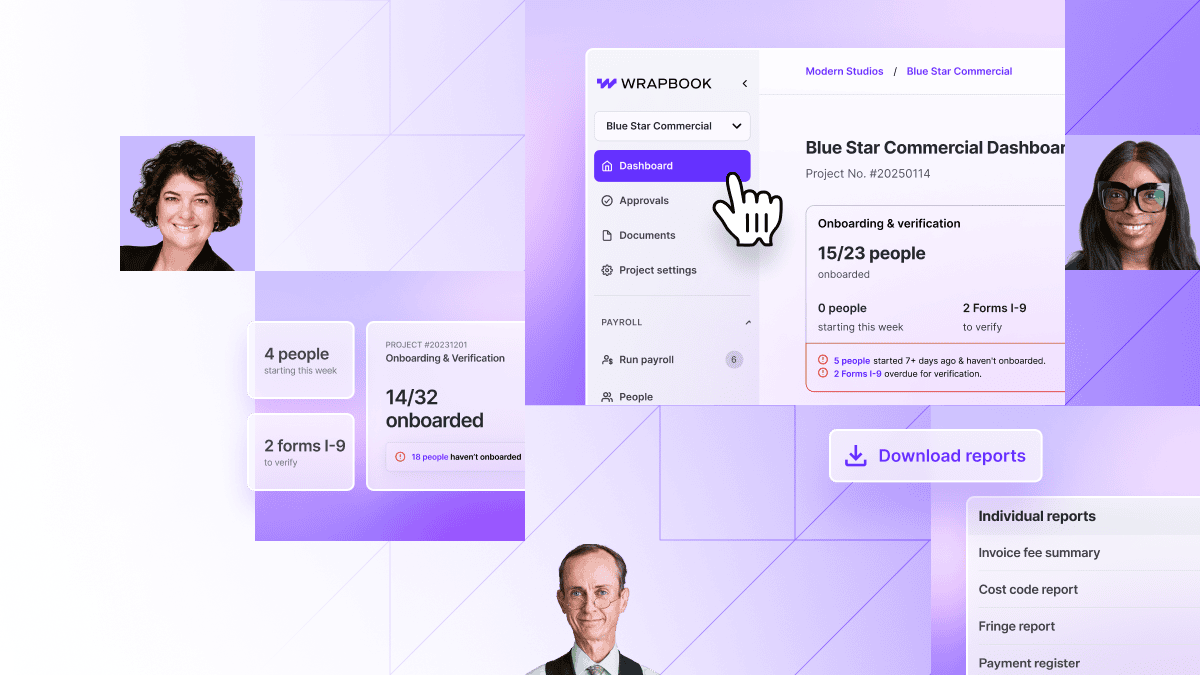
Built-in compliance, total visibility. Get peace of mind with Wrapbook.
While an employer of record takes on many administrative and compliance responsibilities, it does not manage or control your day-to-day business operations. Your company retains full responsibility for supervising employees, setting workloads and schedules, directing their work, and managing workplace culture and performance.
An EOR’s role is focused on payroll, tax withholding, workers’ compensation, unemployment insurance, and other statutory compliance—not on how employees perform their duties or how your operations are run.
An employer of record can free up valuable time your team would otherwise spend managing payroll, tax filings, and HR-related compliance. By outsourcing these administrative responsibilities, you can focus on the strategic and creative aspects of running your business, rather than getting bogged down in paperwork and regulatory details.
EORs like Wrapbook act as a digital employer of record, handling payroll compliance, workers’ compensation coverage, unemployment insurance, and other statutory obligations on your behalf.
One of the biggest advantages of using an EOR is multi-state compliance. Employment laws vary from state to state—and often from city to city. An EOR already maintains the necessary registrations and stays current on changing regulations, making it far easier for your business to hire legally and compliantly across multiple jurisdictions.
Many EORs also support teams with mixed worker classifications, helping companies ensure proper documentation and tax handling for both employees and independent contractors.
In short, an employer of record offers a cost-effective way to outsource payroll, benefits administration, and compliance, saving your business time, money, and risk.
If you’re interested in partnering with an EOR to simplify legal and payroll compliance—and want to test the experience before committing—you can easily schedule a demo to see how Wrapbook streamlines the entire process.
Professional employer organizations (PEOs) are another type of third-party service that supports businesses with HR and administrative functions. While EORs and PEOs may appear similar at first glance, they operate under fundamentally different legal and operational models, making it important to understand the distinction.
The differences become especially significant when managing employees across multiple states or in situations where employment regulations are complex. Below are a few key points to consider when comparing an EOR to a PEO.
A PEO enters into a co-employment relationship with its client. This means that certain employer responsibilities are shared: your business remains the primary employer, while the PEO acts as the administrative employer. Importantly, the PEO is not the full legal employer of your workers.
Under this model, employment contracts remain between your company and your employees. The PEO signs a separate service agreement with your business, outlining the administrative functions it will manage.
An EOR operates differently. An employer of record becomes the legal employer of your workers for tax, payroll, and compliance purposes. Your business signs an EOR agreement with the provider, and the EOR then enters into employment contracts directly with your employees.
Insurance obligations also differ between the two models.
Because PEOs operate under co-employment, businesses must typically opt into the PEO’s insurance plans, which may require additional fees, supplemental coverage, or maintaining your own policies. Arrangements vary by provider, and many businesses end up using a combination of coverage sources.
An EOR, by contrast, carries the required unemployment, workers’ compensation, and disability insurance for the employees it legally employs. Your workers are covered under the EOR’s policies, as outlined in the EOR agreement.
State registration requirements are one of the most significant distinctions between PEOs and EORs, particularly for businesses hiring across multiple states.
When you work with a PEO, your business must still register in every state where you employ workers, because you remain a co-employer. This includes obtaining state tax IDs and ensuring compliance with local labor rules.
With an EOR, those responsibilities shift. If the EOR is already registered to operate in a given state, your business can hire workers there immediately through the EOR, without establishing your own entity or meeting state registration requirements.
This means that even if your company is only registered in New York, you can hire employees across the country—or even internationally—so long as your EOR is authorized to operate in the states or countries where your workers are located.
Running a business is demanding enough on its own. Adding payroll, benefits administration, and evolving compliance requirements can quickly become overwhelming. Fortunately, employer of record services can reduce that burden, helping you stay compliant with federal, state, and local regulations while saving time and operational costs.
If you’re interested in partnering with an EOR that combines next-gen technology with a high-touch service model, the Wrapbook team is here to help. Reach out to learn how we can simplify payroll and compliance for your business.
When a business hires an employee, it takes on far more than the obligation to pay them for their work. Every new hire brings administrative responsibilities, legal liabilities, and complex compliance requirements—many of which can be easy to overlook.
Enter the employer of record (EOR). An EOR is a third-party service that assumes key payroll, tax, and compliance responsibilities on your behalf, helping your company save time, reduce risk, and avoid costly administrative mistakes.
An employer of record (EOR) is a company that takes on the legal and administrative responsibilities of employing workers on your behalf, including payroll taxes, workers’ compensation coverage, and certain employee benefits.
Think of it as an outsourced payroll and compliance department.
An EOR manages payroll and assumes many of the obligations a traditional employer would—such as ensuring compliance with federal, state, and local labor laws related to wages, taxes, and worker protections.
The exact division of responsibilities depends on the agreement between your business and the EOR, but most partnerships generally include services such as:
Most employer of record services include some or all of the following responsibilities:
An EOR manages payroll and related administrative tasks, including issuing payments to employees. This helps ensure workers are paid correctly and on time under all applicable state and federal standards, reducing the risk of costly payroll compliance errors.
EORs calculate and withhold the appropriate employee and employer payroll taxes. Because tax rules vary widely by state, locality, and business type, navigating compliance can be challenging—an EOR serves as an important partner in managing these complexities accurately.
As part of tax withholding and reporting, employers must furnish documents such as W-2s and 1099s. An EOR handles these state and federal filings and may also support related administrative needs, such as documenting reimbursements (e.g., kit fees).
Employees are often entitled to protections like workers’ compensation and unemployment insurance. EORs administer workers’ comp policies and manage claims when they arise, helping ensure compliance with state-mandated benefit requirements.
Accurate onboarding is essential for compliant payroll. EORs ensure new employees are set up correctly in the system and may also facilitate common onboarding steps such as background checks, I-9 verification, or drug testing.


