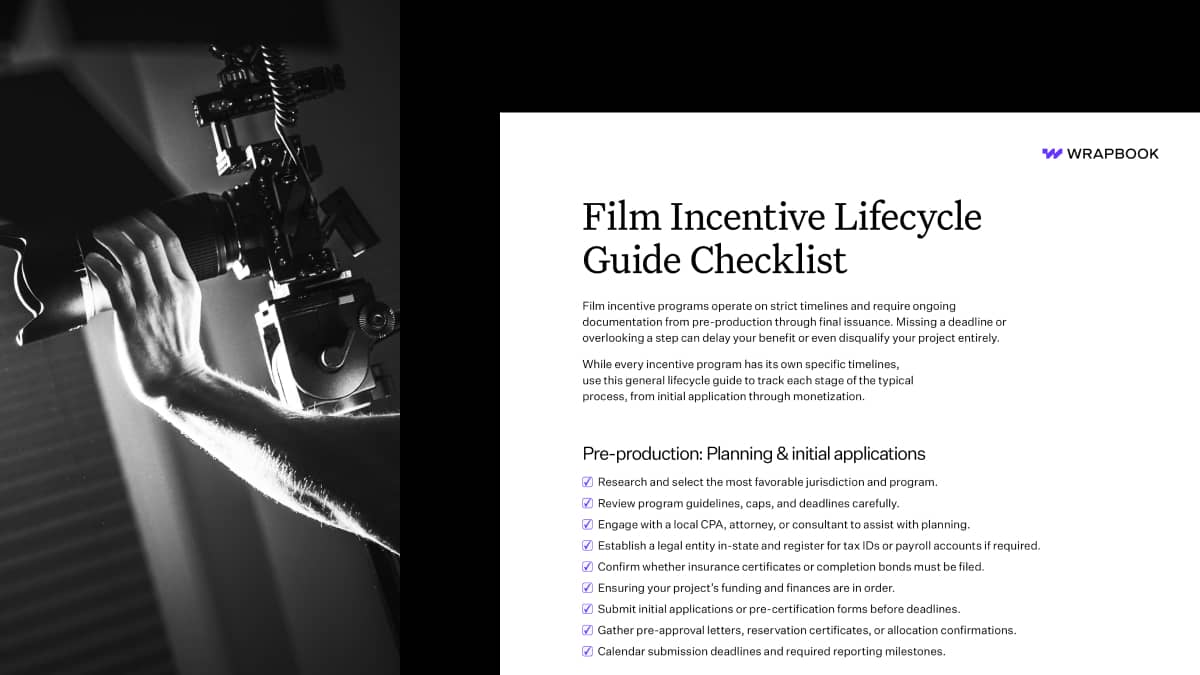
Join the Crew
Get the best resources for producers delivered to your mailbox

Get the best resources for producers delivered to your mailbox


Tom is a filmmaker, producer, and marketing specialist based in Los Angeles.
At Wrapbook, we pride ourselves on providing outstanding free resources to producers and their crews, but this post is for informational purposes only as of the date above. The content on our website is not intended to provide and should not be relied on for legal, accounting, or tax advice. You should consult with your own legal, accounting, or tax advisors to determine how this general information may apply to your specific circumstances.
The District of Columbia is one city with no state lines between its landmarks, so the looks you need sit close together. That means a single shooting day can move from monument to rowhouse block to riverfront with no long company moves in between.
Across the District, productions will find the unique character and history that makes the nation’s capital so special.
The National Mall and Memorial Parks hold more than 100 monuments and memorials, and the Mall itself runs two miles from the Lincoln Memorial to the U.S. Capitol.
Georgetown, the city's original neighborhood, adds cobblestone streets, canal history, and waterfront.

To help filmmakers discover the best of the District, Washington D.C.'s film office, the Office of Cable Television, Film, Music and Entertainment (OCTFME), maintains a location database, issues permits, and connects productions with local crew and vendor resources.
The OCTFME is the center of a vibrant filmmaking community in D.C. From 2016 through 2025, the office supported 85 film and television productions, including the civil rights drama Rustin, Marvel's Captain America: Brave New World, the Netflix thriller Zero Day, and the nuclear-crisis thriller A House of Dynamite.
As part of the OCTFME’s mission to facilitate productions of all sizes, the office also administers District of Columbia film incentives through the District of Columbia Film, Television and Entertainment Rebate Fund.
The District's first production incentive was established by the Film DC Economic Incentive Act of 2006, which took effect on March 14, 2007.
Amendments in 2010 and 2016 evolved District of Columbia film incentives, with the 2016 update creating the Film, Television and Entertainment Rebate Fund that OCTFME administers today.
Most recently, the Maximizing Our Value in Entertainment (MOVIE) Amendment Act of 2026, part of the Fiscal Year 2027 Budget Support Act, set fixed rebate rates effective October 1, 2026.
So what do District of Columbia production incentives look like today? Let's take a closer look...
District of Columbia film incentives return up to 25% of qualified in-District production spending as a cash rebate, paid after production wraps.
The OCTFME film rebate is allocated through the Film, Television and Entertainment Rebate Fund, and the rate depends on what you spend and who you pay:
Productions must spend at least $250,000 in the District on qualified expenditures to qualify for the rebate.
The Rebate Fund is financed through annual appropriations, with funding set at $914,000 through the OCTFME's approved FY 2027 budget. Washington D.C.’s fiscal year runs from October 1 to September 30. Beyond the annual funding allocation, the OCTFME film rebate has no per-project cap.
The District's rebate covers a wide range of project types, from features to video games. Eligible projects include:
Notably, documentaries, commercials, and video games are all eligible for District of Columbia film incentives.
News and current-events programming, live sporting events, political advertising, and radio programs are ineligible for the rebate.
An eligible production company is any entity in the business of producing qualified productions, and it must be current on its District tax obligations.
So what spending counts toward the OCTFME film rebate? And how much can productions expect to get back?
Qualified production spending earns a rebate of 10% to 25%, and qualified payroll expenses can earn 10% to 20%. In both cases, spending has to happen in the District and directly support an eligible production in order to qualify.
To better understand how qualified expenditures count toward a production’s overall OCTFME film rebate, it helps to break spending into two categories: cast and crew payroll and physical production expenses.
Payroll is usually the largest line in a budget, and the rebate pays more when you hire District residents.
Compensation paid to resident cast and crew working on a qualified production in the District can earn a 20% rebate. Personnel expenditures must be subject to DC taxation in order to qualify as resident payroll expenses.
Payroll to nonresident cast and crew (that’s personnel expenditures not subject to
taxation in the District) earns a 10% rebate. Work must be performed in the district in order for the compensation to qualify.
Both above-the-line and below-the-line compensation can qualify, including payments made to loan-out payments. No minimum percentage of a production’s personnel must be District residents in order for payroll expenses to qualify.
Furthermore, there is a $500,000 cap on total above-the-line compensation, meaning the 10% to 20% payroll rebate will only apply to the first $500,000 of combined above-the-line pay for a production.
Along with payroll expenses, a broad list of in-District production costs qualifies under OCTFME's qualified expenditure guidelines:
For “goods with a purchase price of $25,000 or more,” only the purchase price minus the item's fair market value at the end of production qualifies. Marketing and distribution expenditures and non-production overhead don't qualify.

In general, goods and services purchased outside the District do not qualify for the DC rebate. Under District of Columbia production incentives, vendors based in Maryland, Virginia, or elsewhere can qualify only if they hold a DC sales and use tax certificate and collect DC tax at the time of the transaction, according to OCTFME.
Spending incurred at DC-registered businesses that do not charge DC sales or use tax, such as unprepared groceries for craft services, can qualify for the 10% rebate rate as opposed to the 25% rebate for expenses subject to DC taxation.
For help determining which vendors qualify for District of Columbia film incentives, the OCTFME recommends productions share their list of prospective vendors with the rebate program’s administrative staff, who can provide direction.
The OCTFME film rebate comes with a short list of requirements, and most of them apply before you shoot.
Because funding is appropriated annually, contact OCTFME early in your budgeting and planning.
Applying for District of Columbia film incentives starts with OCTFME's online rebate application, and the timing matters: you must apply and be approved before principal photography begins. Media production projects use one form, and infrastructure projects use a separate one.
A typical production application includes:
OCTFME responds to applications within 20 business days. If your project is approved, you'll enter into a rebate agreement that includes a preliminary estimate of your payment.

After production wraps, you submit receipts and proof of qualifying expenditures along with your CPA audit. OCTFME or its accounting agent has up to 90 business days to verify and certify your request, then sends an itemized Certified Qualifying Spend Letter. Sign and return it within 14 business days, and payment follows within 45 business days.
OCTFME administers the rebate and is the District's film commission. Beyond incentives, the office issues film permits, helps with location scouting, and connects filmmakers to the District’s talented base of local crew and vendors.
Productions planning to shoot in Washington D.C. should contact OCTFME as early as possible to confirm current funding availability through the OCTFME film rebate and connect with other support services in the city.
Whether you're shooting a feature, a series, a documentary, or a music video, District of Columbia film incentives can help your productions maximize its budget when shooting in the nation’s capital.
To see how the District compares with programs nationwide, visit Wrapbook's Production Incentive Center and try the Incentive Comparison Tool. For a broader look at how film incentives work across the country, check out our state-by-state guide.
Wrap a scene beneath the Capitol dome in the morning, and you can be on a cobblestone Georgetown street by lunch. The District of Columbia is that compact, and that camera-ready.
Monument-lined avenues, rowhouse blocks, and the miles of picturesque riverfront give productions plenty of scenery to work with. District of Columbia film incentives sweeten the pot with a cash rebate that can help maximize your budget in the nation’s capital.
In this guide, we're breaking down how District of Columbia production incentives work, who qualifies, what spending counts, and how to apply.
Before we get into the details of District of Columbia film incentives, we invite you to take a moment to explore Wrapbook's Production Incentive Center.
The Production Incentive Center is a comprehensive resource designed to help producers research, compare, and navigate film incentive programs across the United States and its territories.
With the State Incentive Map, you can browse programs nationwide. Or use the Incentive Comparison Tool to see how the District stacks up against nearby programs in Maryland, Virginia, and Delaware.
Whether you're comparing minimum spends or using the Incentive Finder to search by project type, the Production Incentive Center makes it easy to find the right program for your next production.